Why Do Sink Marks Show at Rib Roots After Coating?
A rib root pulls in as a shallow dip (the sink mark) when the 2.0 mm rib meets a 2.5 mm wall. That junction is a hot spot, carrying more metal than the rib or the wall, so it stays liquid after the wall sets and the face above it draws in as the root freezes. Coating does not cause the sink mark.
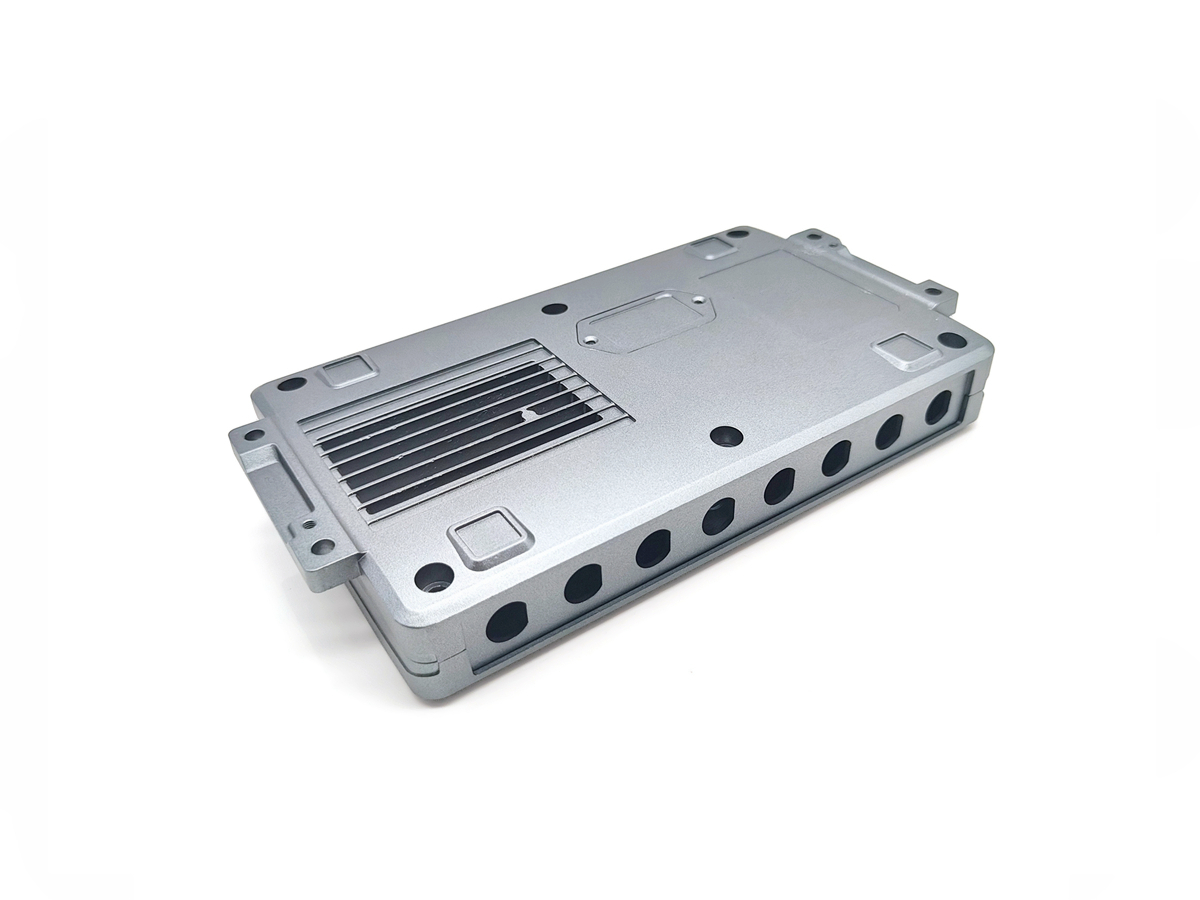
The part is an aluminium enclosure, assumed to be high-pressure die cast in ADC12 to ASTM B85 in the as-cast F temper, with process, temper and grade all pending foundry sign-off.
Why does a rib root sink on the coated appearance face?
A rib root ends in a sink mark because the rib-to-wall junction is a hot spot that freezes last, and the shrinkage that follows pulls the nearest free surface, the appearance face.
The root is still being fed while the wall sets, and the volume loss pulls the face into the sink mark. A film-thickness gauge cannot catch it, because the fault sits in the casting.
Gate and overflow are design targets pending foundry sign-off: the gate at the thick floor feeds the rib root through the wall, and overflow sits at four corners. Because the root is a hot spot inside the die, the fix costs a die cut, a gate or overflow change, and a new first article.
How does a 2.0 mm rib meet a 2.5 mm wall?
The rib is drawn at 2.0 mm against a 2.5±0.2 mm wall, so the junction is a hot spot in a wall meant to stay thin.
Die casting fills the wall, and the rib adds stiffness. At the junction, the hot spot is heavier than either the rib or the wall, and the last metal to freeze sits there. A thicker rib, added for stiffness, puts more mass at the same point and deepens the sink mark.
The wall tolerance of ±0.2 mm moves the root too, and because the rib thickness lives on the die, a change costs a fresh die cut and a first article.
| Feature | Target (mm) | Allowed range (mm) |
|---|---|---|
| Rib thickness | 2.0 | design target, no tolerance released |
| Wall thickness | 2.5 | 2.5 ± 0.2 |
Why does powder coating make the sink more visible?
Powder coating at 60–80 µm adds a uniform layer that follows the surface contour, so the sink mark keeps its slope and reads as a shadow instead of a colour change.
A smooth coat raises the contrast at the sink mark edges, and the shadow reads darker than the face around it. The layer covers colour; it cannot level a slope.
That is why the appearance callout belongs to the coated part: a reject found after coating costs a strip and a recoat, and the callout has to name the coating stage, where the inspector sees the finished face.
How is a sink mark judged under a D65 lamp?
Judging a sink mark is a visual check: an inspector views the coated face under D65 light at 300 mm, and a sink mark that reads as a shadow at that distance is a reject.
D65 is a daylight illuminant, so each inspector sees the same contrast, and the distance sets how much slope is visible.
The check needs a D65 booth and bench time, not a CMM. If the lamp, the distance and the stage never reach the drawing, another inspector reads the face in daylight and judges it differently.
What changes first, the rib thickness or the die?
Changing rib thickness means changing the die, so the real choice is die change versus texture change.
A die change re-cuts the root or moves the gate, then proves the result on a new first article. A texture change scatters light at the sink mark edge; the depth does not change and the 300 mm callout still judges it.
The die change is a tooling cost paid once; a texture change is a setting paid when the finish changes.
Before a quote, send the rib and wall sections, the appearance callout with lamp and distance, the coating stage it applies to, and the batch size. Die work and coating work sit on two lines; folding them together hides the die cut.