How Does Water Chemistry Affect Brass Fitting Corrosion?
Water chemistry affects brass fitting corrosion by changing the reactions at the metal surface and inside threads, ports, seats, and deposits. A request for a “water-service brass fitting” is incomplete unless the buyer also defines temperature, pH where known, dissolved salts, disinfectants or cleaners, flow, stagnation, deposits, and exposure duration. The same brass alloy can experience different corrosion risks in clean circulating water, warm stagnant water, chloride-bearing water, or a system that is periodically cleaned with chemicals.
The first decision is therefore environmental definition, not a universal alloy ranking. Record the fluid that will contact the fitting and identify what is unknown. If the application is a plumbing, pump, HVAC, or process connection, include start-up, shutdown, storage, cleaning, and abnormal exposure conditions where they are credible. State the failure that matters: discoloration, pitting, wall loss, thread damage, loss of seal, or leakage. This turns “corrosion resistant” into a condition that can be reviewed and tested.
Chemistry Variables That Change the Risk
pH can affect the stability of the surface film and the balance of reactions at the fitting. Chlorides and other dissolved species can contribute to localized attack in susceptible conditions. Dissolved oxygen, disinfectants, hardness, suspended particles, and deposits can change local chemistry. Temperature affects reaction rates and can alter the behavior of seals, coatings, and trapped fluids. These variables should be treated as application inputs rather than assumptions based on the word water.
Flow matters as well. High velocity, turbulence, a small passage, or suspended solids can raise an erosion-corrosion concern. Stagnation can allow deposits, concentration changes, and crevice conditions to develop. An intermittent system may expose the part to repeated wetting and drying, while a continuously circulating system may maintain a different surface condition. The fitting geometry and the assembly orientation should be included in the review.
Service input | Why it matters | Buyer action |
|---|---|---|
pH and dissolved species | Can change surface reactions and local attack | Provide available analysis and identify uncertainty |
Temperature | Changes reaction, seal, and coating conditions | State normal, peak, and transient exposure |
Flow and particles | May increase turbulence or erosion at passages | Describe flow path, velocity basis, and solids |
Stagnation and deposits | Can create concentrated or crevice environments | Review drains, threads, cavities, and cleaning |
Connect Chemistry to the Alloy Choice
Brass alloy selection should be made against the fluid and the fitting function. A grade chosen for machining or appearance may not be the correct choice for a specific water environment. A grade selected for a water restriction still needs a casting and machining plan that produces a sound pressure boundary. Do not use a general family name as a substitute for the required material designation, compliance review, or customer specification.
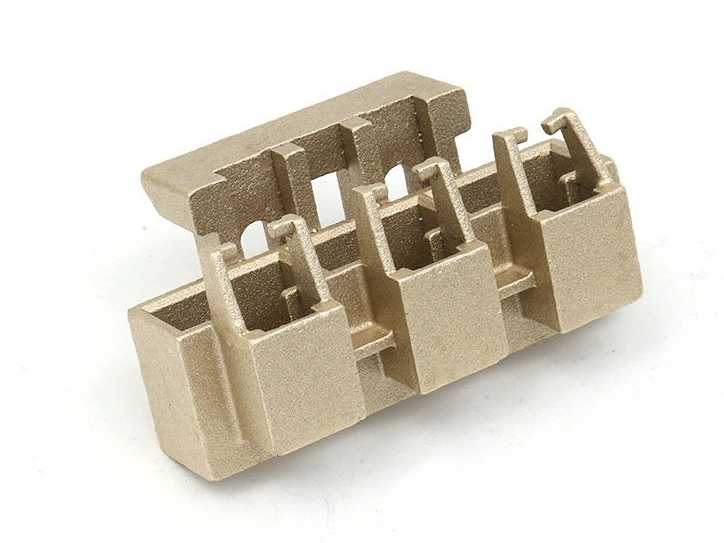
For a casting, examine heavy bosses, cored passages, thin port walls, and machined sealing faces. A discontinuity that is hidden in the rough casting may be opened when a bore or thread is cut. Water chemistry can accelerate the consequence, but it does not make an unsound pressure boundary acceptable. The copper-alloy casting service should be quoted with the alloy, geometry, machining, finish, and inspection scope connected.
Use Representative Testing
A coupon exposure can help screen candidate materials or finishes, but it may not reproduce a threaded, machined, sealed fitting. A production qualification should use the relevant alloy, finished geometry, surface preparation, mating materials, fluid, temperature, flow or stagnation condition, and duration. Define the pass/fail result before testing. A visual color change is not equivalent to a leak, and a pressure test does not answer every corrosion question.
Keep the test sample traceable to the cast lot, machining state, finish, and assembly. If the service chemistry varies, specify which condition the evidence represents and when a re-review is required. A change in cleaner, sealant, pipe, fastener, plating, or operating temperature can change galvanic or crevice exposure. The original result should not be extended automatically to a materially different assembly.
What to Include in the RFQ
Provide the drawing, fluid description, available water analysis, pressure, normal and peak temperature, flow or stagnation, service duration, mating metals, seal, thread, finish, quantity, and inspection requirement. Mark fluid-contact surfaces, pressure boundaries, cosmetic zones, and no-coating features. Ask the supplier to identify the proposed alloy and explain why it fits the stated exposure.
Include a defined machining and cleaning scope. The post-machining route should state how ports, threads, bores, seats, and gasket lands will be established and inspected. If a finish is needed, request the surface preparation, masked areas, adhesion or appearance check, and effect on functional interfaces. These details make quotes comparable and prevent a generic water-service claim from hiding the real risk.
If water chemistry is unavailable, state that the material release is provisional. Use a conservative application envelope for engineering review and request the supplier's assumptions in writing. The responsible product team should approve those assumptions before tooling or production release. The correct answer may be a different alloy, an isolation feature, a different finish, a geometry change, or a representative test rather than a simple brass substitution.
Water chemistry controls brass corrosion decisions because the environment controls the mechanism. Define the chemistry, relate it to the fitting geometry and assembly, and verify the finished part against the failure that the customer cannot accept. That process gives the buyer a defensible material choice without treating “water” as a single standardized condition.