Why Does Plating Look Thin Inside a Bezel Retaining Ring?
Plating looks thin inside a bezel retaining ring because the cavity between the three claws shields the current, so the inner wall receives less metal than the outer band. The bath can be right and the inner face still sit below the 3 µm floor, while a plated ring looks finished outside and fails a reading inside.
The part is a Ø26 × 2.0 mm ring of Zamak 5 cast to ASTM B86 AC41A, with a 0.8 mm wall and three claws set 120° apart, all design targets. Plating comes last, behind de-gating, tumbling and polishing and degreasing, so the surface entering the bath already has its final shape.
Why does the inside of the ring plate thinner?
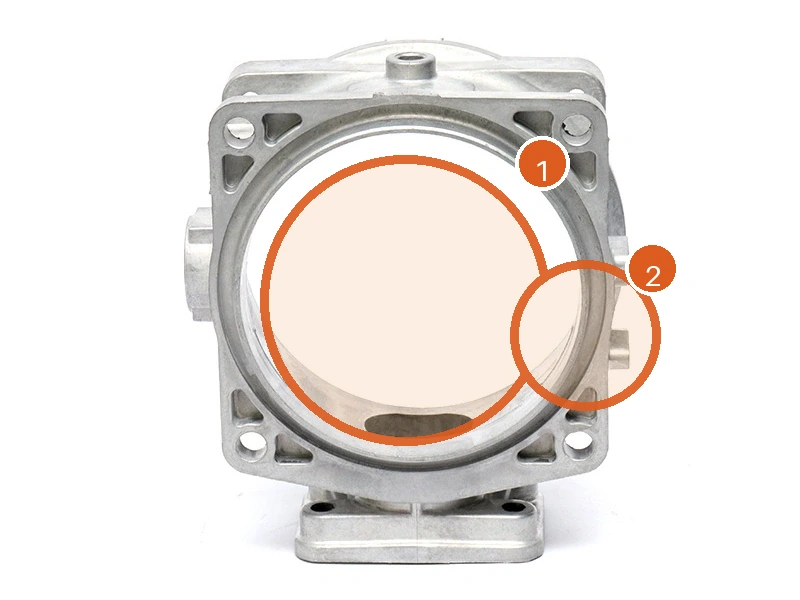
The recess acts as a shield, so metal deposits fastest where the field reaches a surface without obstruction, and the bottom of a pocket is the last place it arrives. Here the inner wall sits behind an opening 2.0 mm deep, so geometry holds current away from the face that must be covered.
Throwing power explains the rest. A bath that plates into deep recesses well coats more of that wall than one that does not, while rack position decides which recesses the bath has to reach. A ring hung flat or masked over the opening collects less current inside than one hung with the cavity open to the anodes. Two rings from one lot can leave the tank with different inner readings.
Which film thickness counts as covered?
Three micrometres is the floor, read by X-ray on the face in question, and it sits at the bottom of the typical 3–5 µm nickel range, so a shielded face has no margin. A 5 µm reading on the outer band says nothing about the 0.8 mm wall behind it.
Name the spot before the batch starts. Inner wall and outer band are different faces with different coverage, and one number taken on the band answers the wrong question. Put the face, the spot and the gauge in the first-article report, then measure that spot on later orders.
Which inner surfaces actually carry the fit?
The three claw tips hold the crystal edge, the base face seats on the case, and the outer band sets the diameter. Those faces need full thickness because they touch something. The rest of the cavity is structure and can plate thinner without moving the fit.
That split changes the rack and the masking. Blocking a non-contact face costs less than plating the whole cavity to 3 µm, and it sends current to the surfaces that carry load. Coverage is a drawing decision before it is a plating decision.
How does nickel only differ from Cu/Ni/Cr here?
Nickel and Cu/Ni/Cr differ in corrosion path and appearance rather than in reach into a recess, since both plate into the same shielded cavity. Nickel alone at 3–5 µm leaves a grey barrier over Zamak 5. A copper–nickel–chrome stack adds Cu 8–12 µm, Ni 5–8 µm and Cr 0.1–0.3 µm, a typical total of 13.1–20.3 µm by addition.
Copper levels the surface, nickel seals it and chromium supplies the hard bright skin, which is why the three-layer finish suits an exposed bezel. A thicker stack does not plate into the cavity better than nickel alone: the shield is still there, and the inner wall can still land below the floor. Assembly requirement picks the stack, and coverage is proven either way.
What proves coverage before the batch ships?
Three checks answer it together: X-ray film thickness on the named faces, thermal shock to ASTM B571 with no blister, and 96 h of salt spray to ASTM B117. A blister after thermal shock points to adhesion between layers, and corrosion on the inner wall points to a thin spot.
A visual pass proves only that the band is bright. Coverage inside is proven by a number taken from the cavity, which is why the sample plan names an inner face before the run. The tests are quoted lines, and the reading releases the batch, not the shine.
| Item | Figure | What it settles | Checked with |
|---|---|---|---|
| Nickel, outer band | 3–5 µm | Visible face | X-ray film thickness |
| Nickel, inner wall | 3–5 µm | Contact face | X-ray film thickness |
| Three-layer stack | 13.1–20.3 µm | Finish and corrosion path | Layer readings added |
| Thermal shock | No blister | Adhesion | ASTM B571 |
| Salt spray | 96 h | Thin spots | ASTM B117 |
Send the drawing with the faces that must reach 3 µm marked, the stack named, and the rack arrangement agreed before the first batch. Those three answers turn a plating complaint into a release criterion a second supplier must meet.