What industries benefit most from complex geometry sand casting?
Industries benefit most from complex-geometry sand casting when they need a large or irregular metal envelope, internal flow passages, a foundry alloy, near-net material use or low repeat demand that does not justify a permanent die. Common application groups include industrial pumps and valves, heavy machinery, power equipment, vehicle development, marine hardware and selected aerospace structures. Industry membership alone does not make the route suitable; drawing, alloy, quantity, process capability and qualification evidence decide.
Screen the Part Before the Industry
Sand casting adds value when a disposable mold or removable cores solve a real manufacturing constraint. A simple precision block may be better machined. A thin high-rate housing may suit permanent mold or die casting. A fabricated assembly may provide easier repair and passage inspection. Start with geometry, size, material, annual demand, change rate, final tolerance and consequence of hidden defects.
| Application attribute | Why sand casting may fit | Qualification question |
|---|---|---|
| Large irregular housing | Near-net envelope without removing a large billet | Can it be fed, handled and machined from stable datums? |
| Internal fluid network | Removable sand cores form enclosed passages | How are core position, cleanliness and leakage verified? |
| Foundry alloy in low repeat demand | No permanent production die is required | Is the exact grade and melt evidence available? |
| Consolidated structure | Several shapes may be cast as one body | Does consolidation worsen shrinkage, repair or inspection risk? |
| Development geometry likely to change | Pattern or printed-sand data can be revised | Which prototype conclusions transfer to production? |
Pumps, Valves and Fluid Equipment
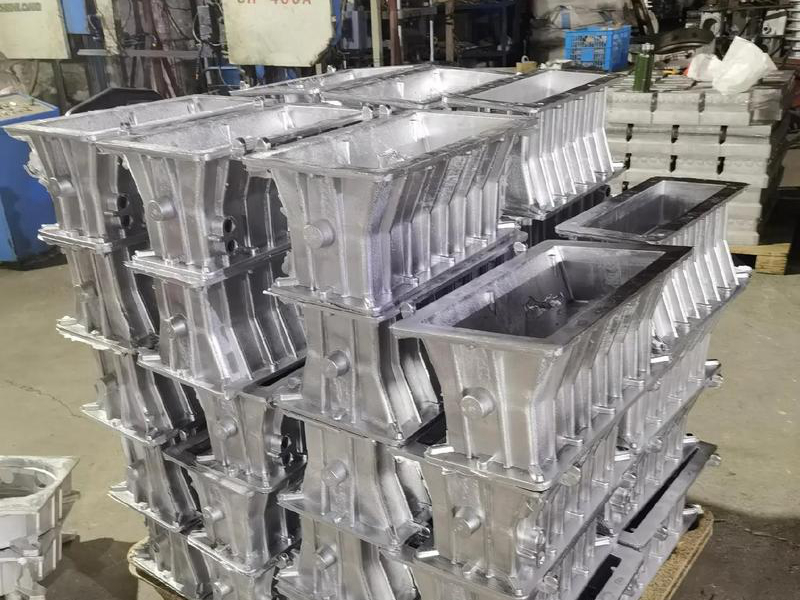
Pump casings, valve bodies and manifolds can use cored flow paths and irregular pressure envelopes. Sand casting may reduce fabrication joints and place material around volutes or branches. The difficult work is not merely creating the cavity. The supplier must control core location, wall cleanup, flange machining, material condition and internal discontinuity risk.
Acceptance may include passage continuity, residual-sand cleanliness, dimensional alignment, hydrostatic or pneumatic testing and selected nondestructive examination. Test medium, pressure, duration, safety setup, allowable leakage and delivered state must be specified. A casting grade described as corrosion resistant does not replace compatibility review for the actual fluid and temperature.
Heavy Machinery and Power Transmission
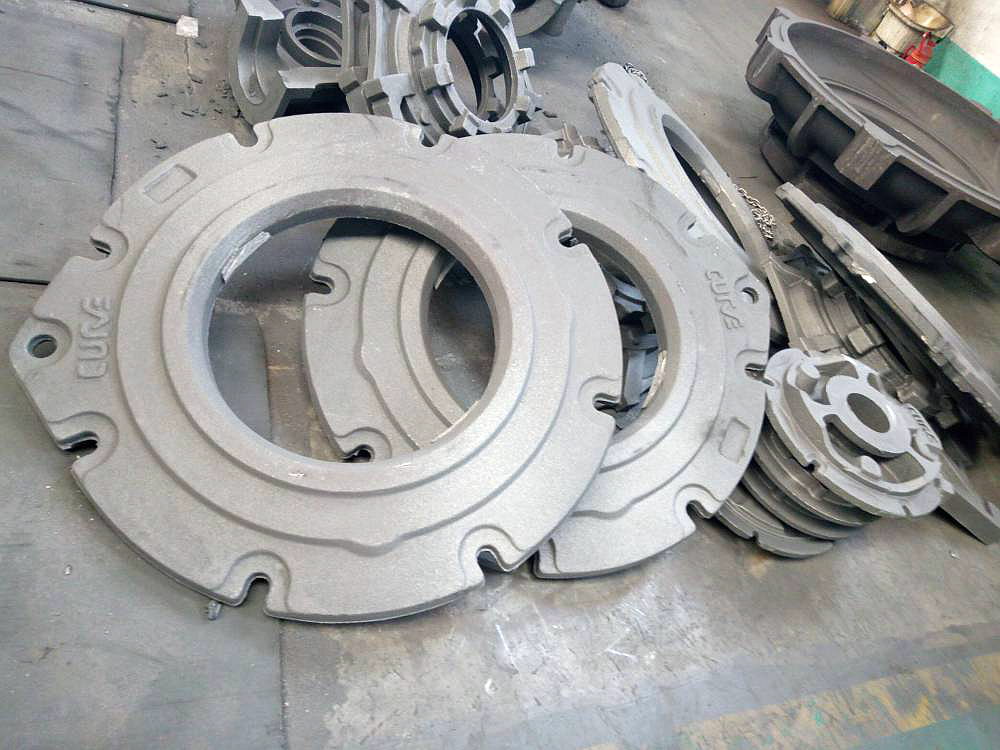
Gearbox housings, bearing carriers, hydraulic bodies and machine structures often combine a broad as-cast envelope with machined bores and mounting planes. Sand casting can reduce material removal on large parts and integrate stiffening ribs or oil paths. Gray iron, ductile iron, steel, aluminum or copper-alloy options may be considered according to load, damping, wear, mass and environment.
Buyer evidence should focus on bore alignment, bearing-seat stock, datum stability, core-derived oil passages, heavy-junction soundness and heat-treatment condition. One-piece consolidation should be compared with fabrication for repair, welding access and field service. A large casting that cannot be fixtured or inspected may not lower total cost.
Energy and Thermal Systems
Generator, compressor, turbine-adjacent and heat-management housings may have cooling circuits, volutes, ribs or large structural sections. Sand cores can form these internal volumes while machining establishes shaft, seal and connection interfaces. Material choice follows pressure, temperature, corrosion, erosion, thermal cycling and joining conditions.
Qualification can require chemistry, heat treatment, dimensional reports, leak/proof tests, internal-quality examination and functional flow or thermal testing. These requirements vary by equipment class and owner specification. Sand casting is a manufacturing route, not automatic certification for power service.
Vehicle and Mobility Development
Engine-development castings, transmission housings, motor housings, suspension prototypes and large brackets can benefit when engineers need metal geometry before permanent tooling. Cored coolant or lubricant passages and near-net envelopes make the route useful for selected prototypes and low-volume programs. A sand-cast prototype can reveal assembly, machining and some material behavior.
It does not automatically validate a later high-pressure die-cast or permanent-mold production part. Fill, cooling, porosity, dimensions and microstructure change with process. Define which product interfaces and tests transfer, then repeat process-specific DFM and qualification before production release.
Marine and Corrosive-Service Hardware
Propulsion, pump, valve and deck-equipment parts may use bronze, brass, steel, iron or aluminum casting grades where their exact composition and condition fit the environment. Sand molds support large envelopes and cored water paths. Corrosion behavior still depends on alloy grade, seawater chemistry, galvanic contacts, velocity, temperature, surface condition and maintenance.
Specify restricted elements, material records, pressure or load tests, corrosion-related acceptance and any repair limitations. A generic bronze label or a successful freshwater test does not establish long-term seawater suitability. Consult the application specification and material authority.
Aerospace and Other High-Consequence Structures
Selected aerospace, defense or other high-consequence programs may evaluate sand casting for large shapes, development hardware or approved low-rate components. The process is only one part of eligibility. Drawing authority, approved material/process specifications, traceability, special-process controls, inspection qualification and part testing govern acceptance.
Do not infer flight, medical, nuclear or safety certification from alloy family or supplier equipment. Separately cast coupons may not represent a local cored wall or heavy junction. Qualification should identify representative material evidence, internal-quality requirements, repair rules and change notification for the actual component.
When Another Route Is Better
CNC machining may win when stock is available, geometry is open and nearly all surfaces require precision. Fabrication may win when passages need direct inspection or field repair. Investment casting may suit smaller detail and surface needs; permanent mold or die casting may justify dedicated tooling at stable repeat demand; metal additive manufacturing may suit compact internal networks within its material and build constraints.
Normalize comparison at the same delivered state: alloy condition, machining, finish, inspection, reports, accepted quantity and schedule. The framework for sand casting versus CNC and additive routes can structure the quote review.
Buyer Qualification Checklist
Send CAD, drawing, alloy/final condition, demand, service loads and media, critical passages, datums, machining, finish, cleanliness, leak/load/material tests, reports and applicable specifications. Ask the sand casting supplier to return mold/core strategy, process limitations, first-pour evidence, outsourced operations, capacity, inspection and deviation list.
The sectors that benefit most are those whose parts match the route's attributes and whose acceptance plan can control its risks. Select sand casting because the consumable mold, cores, alloy access and near-net form solve the specific program, not because an industry name appears on an application list.