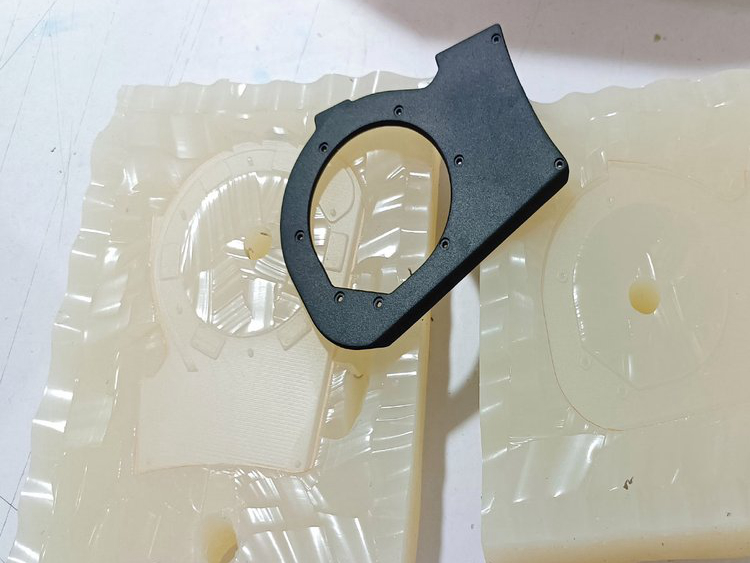
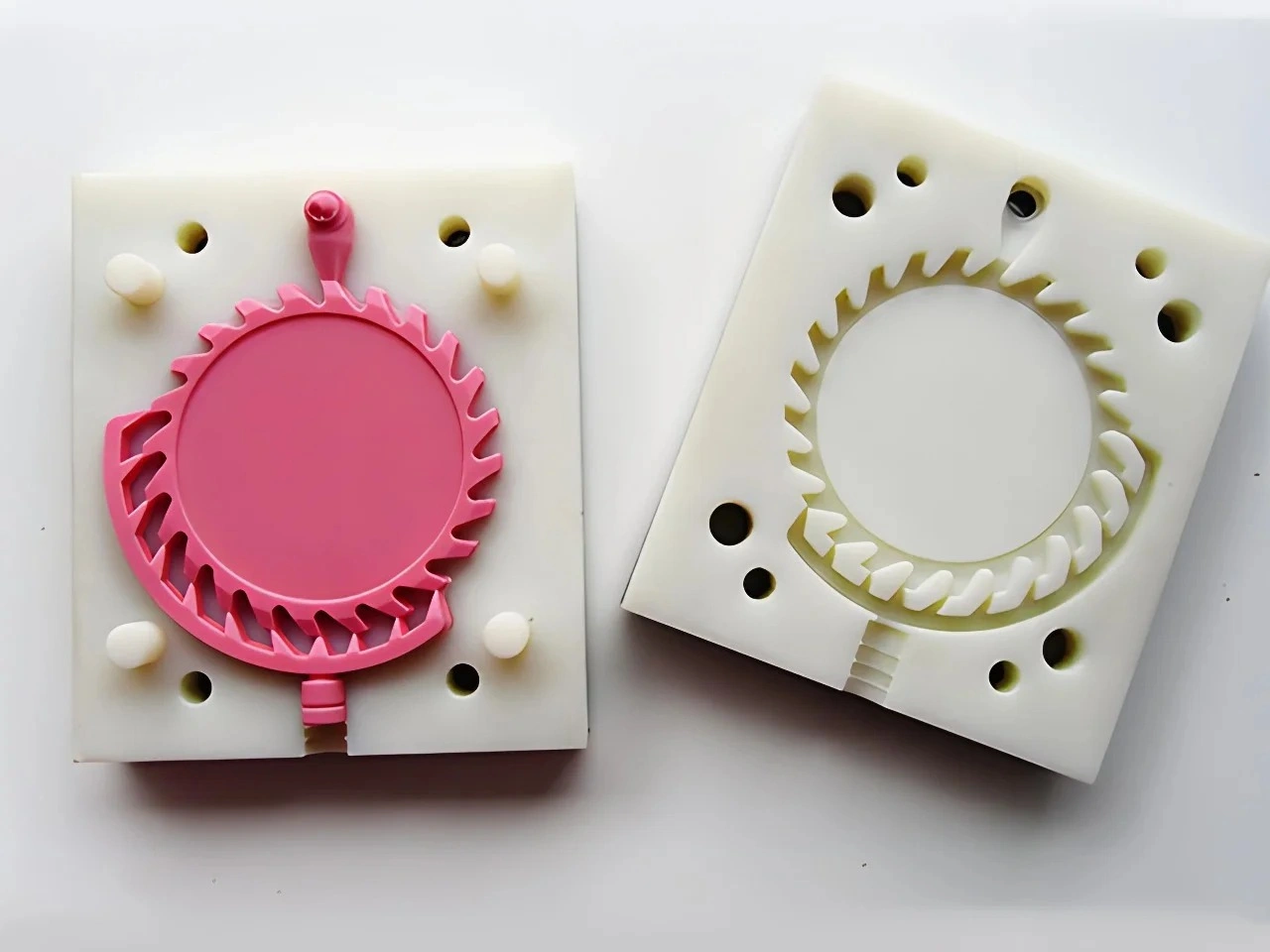
How do multi-material or dual-durometer prototypes work in urethane casting?
Multi-material or dual-durometer urethane prototypes are made by placing two resin systems, or a resin and an insert, into controlled zones through sequential casting, separate casting and bonding, or mechanical retention. The parts may share one mold concept or require several mold states. Success depends on exact resin compatibility, interface geometry, location, cure/conditioning and the test the boundary must pass; visual continuity alone does not establish a durable bond.
Choose the Construction Route
| Route | Best suited question | Main risk | Verification |
|---|---|---|---|
| Sequential casting | Integrated rigid-soft or color zones | Timing, leakage, boundary shift or cure conflict | Traveler, section and interface test |
| Separate castings plus adhesive | Replaceable materials or accessible joint | Bondline, contamination and fixture variation | Bondline inspection and bounded load |
| Mechanical interlock | Interface geometry and retention concept | Air traps, incomplete fill or local tearing | Section, pull/compression or assembly test |
| Cast-in rigid insert | Hardware, window, contact or structural carrier | Insert movement, leakage and local stress | Location and functional retention check |
Start with a Material-Zone Map
Mark rigid, flexible, clear, colored, metallic and adhesive zones on controlled CAD or drawing. Identify the boundary, cosmetic side, allowed flash, thickness transition and functional purpose. A soft grip and a sealing lip may use similar hardness but demand different geometry and tests.
State the target production construction. Prototype zones can approximate design intent while production may use thermoplastic overmolding, elastomer molding, adhesive, welding or mechanical assembly. Record that process substitution before interpreting results.
Sequential Casting Needs More Than a Pause
The first material may be cast and cured to a controlled state, removed and repositioned, or retained in a mold state before the next resin is introduced. Temporary blanks or mold inserts can reserve the second zone. Exact sequence depends on geometry, resin chemistry and access; it is not automatically one pour followed by another in a closed tool.
Define first-material condition, surface preparation, location method, second-material flow and air escape. Too little stability may deform the first section; too much cure or contamination may reduce chemical interaction. Use supplier guidance and representative trials rather than inventing a universal interval.
Chemical Adhesion Is System-Specific
Chemical adhesion depends on the exact polyurethane pair, cure state, surface cleanliness and interface timing. Similar family names or hardness values do not establish compatibility. Review supplier information and test the actual cast construction.
Where adhesion matters, define loading direction and environment. A short peel, pull, compression or assembly check may support prototype use under stated conditions. Production thermoplastic or elastomer overmolding uses different heat, pressure and chemistry and needs its own qualification.
Mechanical Interlock Can Reduce Adhesion Dependence
Holes, grooves, dovetails, wraparound regions and retained edges can transfer load mechanically. Design them so resin can fill and vent without creating fragile thin sections. Sharp hooks may trap air or tear the soft zone during demolding.
Mechanical retention does not make chemistry irrelevant when sealing or no-gap appearance matters. Inspect section fill and boundary position, and identify whether any visible seam is acceptable.
Cast-In Inserts Need Positive Location
Metal hardware, magnets, windows or rigid carriers can be loaded into silicone tooling before casting. Use positive location against defined references and seal areas where resin leakage is unacceptable. Buoyancy and flow can shift unsupported components.
The insert planning review should cover exposed faces, thread protection, surface preparation, retention and inspection. The resulting stiffness belongs to the documented hybrid construction.
Control the Material Boundary
Boundary flash, color bleed, leakage and mislocation can change both appearance and function. Use mold shutoffs or masks that can close repeatably without damaging the first material. Place the interface where trimming and inspection are possible.
For tactile zones, inspect transition height and edge feel in the assembled orientation. For seals, inspect compression geometry and continuity. A neat cosmetic line does not prove seal or load performance.
Condition Each Material Before Testing
Rigid and flexible systems can have different cure/post-cure and age-dependent behavior. Record both resin designations, batches, cast sequence, cure, part age and conditioning. Test after the construction reaches the agreed state.
The multi-material simulation boundary should accompany results. A passed prototype supports the specified geometry, materials and condition, not every future combination.
Inspect with Sacrificial and Functional Parts
A sacrificial section can reveal fill, voids and interface position that external inspection misses. Pair this evidence with the named functional test on an intact part. If testing consumes or cuts a sample, order enough pieces to preserve an approved reference and complete the required trials.
Define the failure response: surface preparation, resin pair, interface geometry, mold shutoff or cast sequence may need revision. Keep changes traceable rather than repairing a favorable part without updating the process.
Dual-Material RFQ
Send controlled CAD, material-zone map, production construction, target attributes, interface purpose, allowed seam/flash, inserts, appearance, test condition and accepted quantity. Ask for resin systems, molds/inserts, cast order, interface mechanism, cure/conditioning, inspection and remake triggers.
Dual-durometer urethane casting is useful when it creates a controlled material contrast or interface for a specific decision. It should not be described as production overmolding unless the production materials and process have been separately demonstrated.