Benefits of Urethane Casting Prototyping

Urethane casting is most beneficial when a team needs multiple plastic-like prototypes from one stable design revision and wants each set to look and behave consistently enough for assembly, ergonomic, finish or limited functional evaluation. Its silicone tooling can reproduce a prepared master, release selected undercuts and support color, hardness, inserts or secondary finishing without committing to a production mold. Those benefits are conditional: the cast polyurethane is not the production thermoplastic, the mold is a consumable asset, and manual casting and finishing affect variation.
The practical question is therefore not whether urethane casting is fast, inexpensive or versatile in the abstract. It is whether the process produces the evidence required for the next project decision at an acceptable total cost and risk. Buyers should define that decision before requesting a quote, then ask the supplier to identify which requirements can be verified on cast parts and which must wait for production-intent material and tooling.
Benefit Decision Matrix
| Potential benefit | When it has real value | Main limitation | Evidence and buyer action |
|---|---|---|---|
| Repeated parts from one master | Several assembly, review or user-test sets share a controlled revision | Mold condition and manual operations can change output over the run | Approve a first-off sample; track revision, cavity and cast sequence |
| Molded appearance and texture | Stakeholders must judge gloss, texture, color breaks or parting-line placement | The result reflects the master, mold surface and finishing route, not production-tool steel | Approve physical color and finish standards under defined lighting |
| Flexible release | Selected undercuts or re-entrant features can be demolded without damaging part or mold | Deep traps, thin hooks, enclosed voids and fragile cores may still require splits or redesign | Review parting, cuts, core removal and witness marks in a mold plan |
| Property variants | The test concerns a bounded stiffness, hardness, transparency or tactile range | Polyurethane does not prove the behavior of ABS, PC, PP, nylon or another production resin | Choose a cast resin from test requirements and verify coupons or parts in the actual test |
| Lower revision exposure than hard tooling | The geometry is mature enough to mold but may still change after physical evaluation | A revision can invalidate the master, silicone mold and work in process | Freeze a revision for each build and price likely remaster/remold scenarios |
| Bridge quantities | Demand exceeds a few direct prototypes but production tooling is not yet justified or available | Recurring casting, curing, trimming and inspection remain labor-dependent | Compare total delivered cost and schedule by accepted state, not nominal piece count |
Why Repeated Prototypes Can Be More Useful Than One Show Part
A single polished prototype may confirm shape, yet it says little about assembly spread, operator access or user-to-user observations. Urethane casting becomes useful when the same controlled design must be distributed across several test stations, internal reviewers or mating assemblies. The mold provides a common geometric source, while the approved master establishes the intended visible surface.
That repeatability is not the same as injection-molding capability. Vacuum level, mix control, cure history, mold temperature, trimming and post-cure can influence cast parts. A buyer who needs comparative data should identify the cavity or mold, cast sequence and resin batch for each sample. Dimensions should be measured at a stated conditioning time and temperature when moisture, thermal history or flexible sections could affect the reading.
The benefit is strongest when the test population is planned. For an enclosure, for example, one set might be reserved for dimensional layout, another for repeated assembly, another for coating approval and another for stakeholder handling. Destructive tests need their own samples. The urethane casting process scope should be reviewed against that allocation so cosmetic reference parts are not consumed in tests that leave no approved appearance sample.
The Geometry Benefit Has a Demolding Boundary
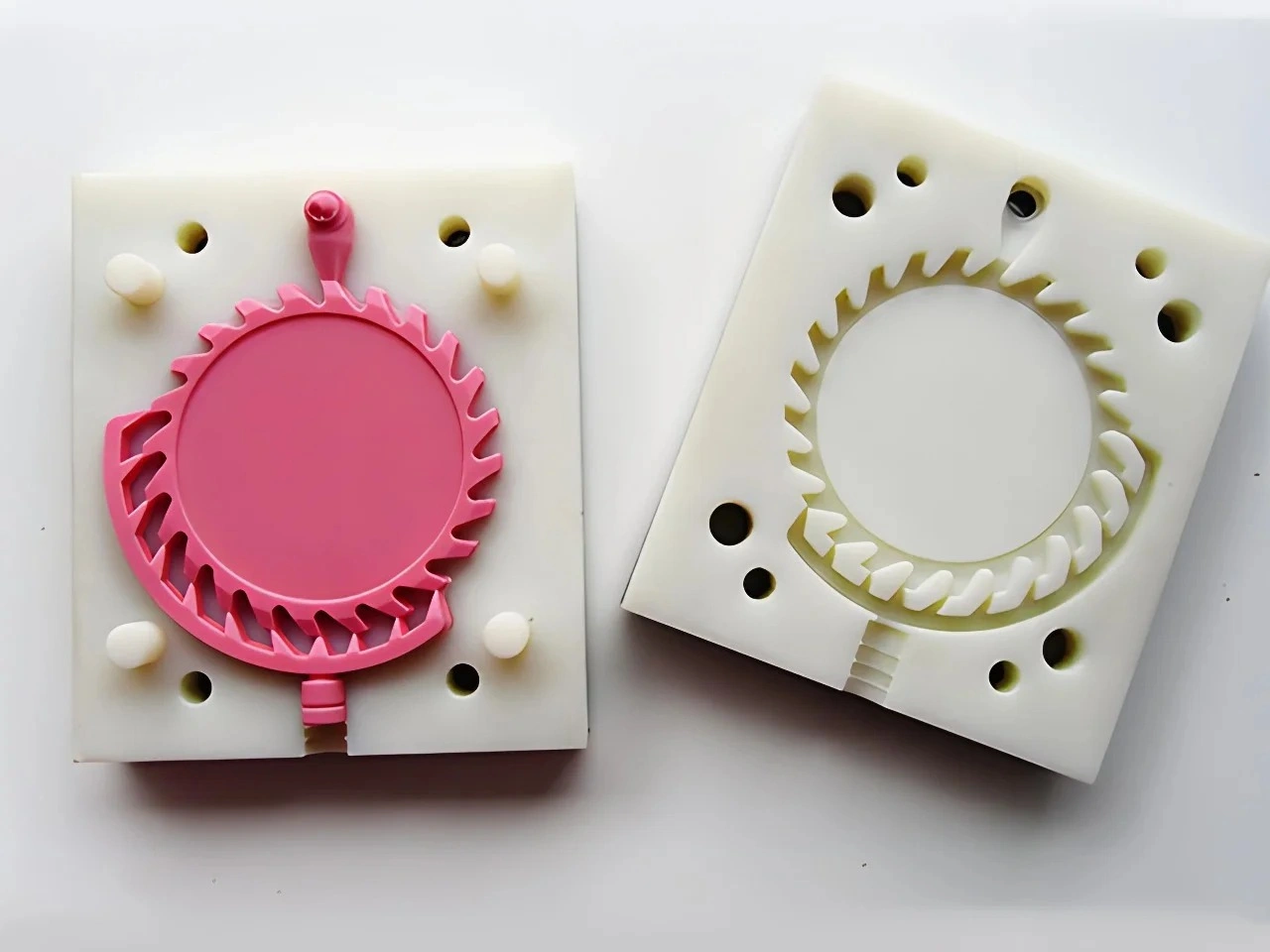
Silicone can flex around some undercuts and textured faces that would require slides or lifters in rigid production tooling. That can preserve an early product envelope and reduce the need to divide a prototype into machined components. It also allows intentional mold cuts, removable cores and inserts to be considered during prototype planning.
Flexibility does not make every enclosed or negative-draft feature castable. The operator still needs a path to remove the cured part without tearing thin ribs, permanently stretching the mold or locking a core inside the component. Long slender passages may trap air or resist filling. Deep hooks can concentrate peel load. A hidden mold cut can leave a witness line on a cosmetic surface, and a removable core creates its own alignment and sealing work.
Ask for a marked mold concept showing parting surfaces, planned cuts, fill and vent locations, loose cores, inserts and trim areas. If a surface is cosmetic, place its acceptance zone on the drawing and agree where witness lines are allowed. For geometry that may later be injection molded, run a separate production DFM review; the prototype release strategy does not validate production draft, ejection or side-action design. The broader complex-geometry and multiple-material review explains why prototype feasibility and production feasibility must remain separate decisions.
Appearance Can Be Reviewed Before Production Tooling
A prepared master can carry intentional texture, gloss and edge treatment into the silicone mold. Cast parts may then be pigmented, painted, polished or selectively masked to create coherent appearance samples. This is valuable for checking color breaks, label position, visual gaps, highlight lines, tactile zones and how several components read as one product.
The evidence is only as controlled as the reference. A digital color value alone does not define the combined effect of resin, pigment, wall thickness, primer, topcoat, texture and lighting. Transparent or translucent parts are especially sensitive to bubbles, flow marks, section changes and post-finish. A glossy master can also reveal minor handling or parting defects that a matte surface would hide.
Supply a physical color standard where appearance matters. Define the viewing face, gloss or texture reference, acceptable witness areas and whether the sample is a concept target or a measurable acceptance standard. Review first-off parts under agreed lighting before finishing the entire batch. For a deeper boundary between molded surface and later finishing, use the prototype surface-quality guide and document all repair, primer and coating steps that contributed to the approved result.
Property Variants Support Bounded Tests, Not Material Equivalence
Cast polyurethane systems are available across different hardness, stiffness, color, clarity and thermal-response ranges. That lets engineers create comparison sets for grip feel, button response, handling, impact-screening, light transmission or fixture development. The useful benefit is the ability to select a candidate around a test question, not a claim that one urethane universally duplicates a named thermoplastic.
Production plastics derive behavior from chemistry, grade, additives, moisture state, molding history, orientation and section geometry. A cast polyurethane may approximate one observable response while differing in creep, fatigue, chemical resistance, flammability, environmental aging or fracture mode. A visually convincing housing therefore cannot qualify a production resin or support a regulated-use conclusion without the required material and process evidence.
Start with the load case and environment. State the temperature range, contact fluids, duration, strain mode, impact location, optical requirement and pass/fail criterion. Ask the supplier for available technical data and lot information, but verify the selected material in representative parts or test coupons. The cast-polyurethane material selection FAQ is a useful screening reference; production qualification must still use the specified production material and manufacturing route.
Multi-Material Prototypes Reveal Interface Decisions
Sequential casting can combine a rigid region with a softer grip, seal, button or bumper. Inserts can also be placed into the mold when their location, retention and surface condition are controlled. These routes help teams judge tactile transitions, local thickness, interface geometry, insert access and whether the assembled product can be handled as intended.
The interface must be treated as an engineered feature. Bonding depends on the selected materials, surface preparation, cure state, contamination, overlap and loading direction. A cosmetic join may be adequate for handling but unsuitable for peel, pressure sealing or environmental exposure. Mechanical interlocks can improve retention, although they also change mold release and production DFM.
Define whether the interface is expected to look continuous, carry load, resist peel, seal fluid or simply hold position during an evaluation. Section sacrificial samples to inspect coverage and voids. Pull, peel, leak or cycle the interface using a project-specific fixture where function matters. Do not use a cast bond result as proof of adhesion between production thermoplastics; use it to refine geometry and the later production test plan.
Iteration Value Depends on Revision Discipline
Silicone tooling generally exposes less capital than engineered steel tooling, so a team can learn from physical parts before final production-tool release. But changes are not free. Altering a CAD model may require a new master, new surface preparation, a new mold, repeated color approval and replacement parts. A small local change may sometimes be handled by modifying the master or mold, but feasibility and resulting witness marks must be reviewed rather than assumed.
Control the CAD, drawing and appearance references as one release. Put the revision on purchase documents and inspection records. Freeze each build long enough to collect coherent evidence; mixing revisions across assemblies produces feedback that cannot be traced. When a change is proposed, identify what existing evidence remains valid and what must be repeated.
For cost comparison, include master manufacture, master finishing, silicone tools, likely replacement tools, casting, trimming, secondary work, inspection, packaging, scrap allowance and revision scenarios. Compare this delivered state with direct 3D printing, CNC machining and production tooling. The lowest nominal piece price can be misleading if it excludes the finish, inserts or reports needed to make the parts usable.
Schedule Benefit Requires a Complete Input Set
Soft tooling can shorten the path to repeated molded prototypes because it avoids metal-tool design, machining, fitting and production-process qualification. That advantage is real when the input revision is stable, the master route is known, materials are available and approval decisions are made promptly. It disappears when unclear cosmetic requirements, repeated CAD changes or unplanned testing stop the work.
The actual critical path includes CAD and drawing review, master manufacture, master finishing and approval, mold construction, resin and pigment readiness, casting and cure, trimming, secondary finishing, inspection, customer review and shipment. Complex parting, inserts, multi-stage casting or tight cosmetic criteria add steps. Mold replacement may affect later lots if the program extends beyond the useful condition of the first tool.
Ask for a milestone schedule with customer dependencies instead of a generic days-scale promise. Identify who can approve DFM, master appearance, first-off dimensions and color. The urethane project schedule analysis shows how to build a critical path from actual deliverables rather than from the casting operation alone.
What Learning Transfers to Production Tooling?
Urethane prototypes can resolve product questions before production-tool release: external envelope, access, mating relationships, human factors, visual hierarchy, some insert locations and selected component-level tests. They can also help the team prepare inspection fixtures, assembly work instructions and packaging concepts, provided differences in stiffness, friction and dimensions are acknowledged.
They do not reveal how production resin fills a metal cavity. They cannot prove gate position, runner balance, weld-line strength, fiber orientation, cooling distortion, ejection behavior, cycle time or production yield. Those are created by the production material, tool and process. Silicone parting decisions also should not be copied automatically into a steel mold.
Create an evidence-transfer register before tool release. Mark each requirement as closed by the urethane build, informed but still open, or production-specific. Attach the supporting report, sample ID and revision. Then carry open items into simulation, production DFM, tool design, first-article inspection and process qualification. This is the real transition benefit: fewer unresolved product questions entering an expensive stage, without pretending that prototype evidence replaces production evidence.
When Urethane Casting Is Not the Best Route
Choose another process when the required evidence is outside cast polyurethane's scope. One rapidly changing concept may be better printed directly because making a master and mold adds no useful repetition. A part requiring the exact stock grade, machined datums or very accessible precision features may favor CNC. A test concerning production resin, molded fiber direction, gate appearance, ejection, cycle or rate requires injection-molded samples.
Urethane casting also loses value when cumulative demand makes recurring manual labor and mold replacement dominate, or when environmental and regulatory requirements demand certified production material and process records. Very large parts, severe thermal exposure, aggressive chemicals, long-term creep loads or demanding pressure boundaries need a process-specific feasibility review. Do not infer suitability from appearance.
Compare routes at the same accepted state: controlled revision, quantity and cadence, inserts, finish, inspection, reports, assembly, packaging and test readiness. This prevents a raw direct prototype from being compared with a painted and inspected urethane assembly. For a focused three-route decision, see the FAQ on choosing urethane, CNC or injection molding in the list below.
RFQ Inputs That Make the Benefits Quotable
A useful RFQ tells the supplier what decision the prototypes must support. Include the following:
- Controlled 3D CAD, a dimensioned drawing and one explicit revision identifier.
- Required quantity by delivery lot, test allocation and any later replenishment cadence.
- Production material and process for context, plus the specific property or appearance that the urethane must screen.
- Critical dimensions, datums, mating parts, measurement method and conditioning requirements.
- Cosmetic faces, physical color or texture standards, allowed parting and witness areas, and viewing conditions.
- Insert specification, thread use, pull or torque expectation, and whether secondary machining is permitted.
- Loads, temperatures, fluids, exposure durations and pass/fail criteria for every functional test.
- Packaging, labeling, traceability, material-data and inspection-report requirements.
- Target production route, open production-specific questions and the planned production-tool release gate.
The cast-urethane RFQ checklist can be used to close missing inputs. Ask the quotation to state assumptions about the master, mold construction, mold replacement, resin, finish, trimming, inspection and acceptance. Unstated assumptions tend to become schedule or cost disputes later.
Release Gates for a Useful Prototype Program
Gate 1: Question and Scope
Write the decision, acceptance criteria and evidence owner. Confirm that cast polyurethane can answer the question. Separate product evidence from production-process evidence.
Gate 2: Master and Mold Plan
Approve the master route and finish, parting strategy, cuts, cores, inserts, fill and vent concept, witness areas and expected inspection method. Record any geometry accepted only for prototype release.
Gate 3: First-Off Approval
Check identity, key dimensions, assembly, surface, color and material designation before authorizing the remaining quantity. Preserve an approved sample and photographs with controlled viewing conditions.
Gate 4: Evidence Review
Link every result to part ID, revision, resin batch where needed, mold or cavity and test condition. Record failures as well as passes; an unexplained prototype failure should not be hidden by selecting a better-looking sample.
Gate 5: Production Handoff
Close transferable product questions and list production-specific items that remain open. Release production tooling only when the team understands what the urethane build proved, what it suggested and what it could not test.
Used this way, urethane casting provides more than attractive samples. It creates controlled physical evidence at a stage when product changes may still be manageable. Its value comes from matching the process to the next decision, documenting its limits and carrying unresolved questions forward without turning approximations into claims.
FAQs
What types of prototypes benefit most from urethane casting?
How does silicone mold flexibility support complex geometries?
Can urethane casting simulate multiple materials or dual-durometer assemblies?
When should engineers choose urethane casting instead of CNC or injection molding?
How do urethane prototypes support the transition into mass-production tooling?