Why Does a Roly-Poly Bank Need a Zamak Weighted Base?
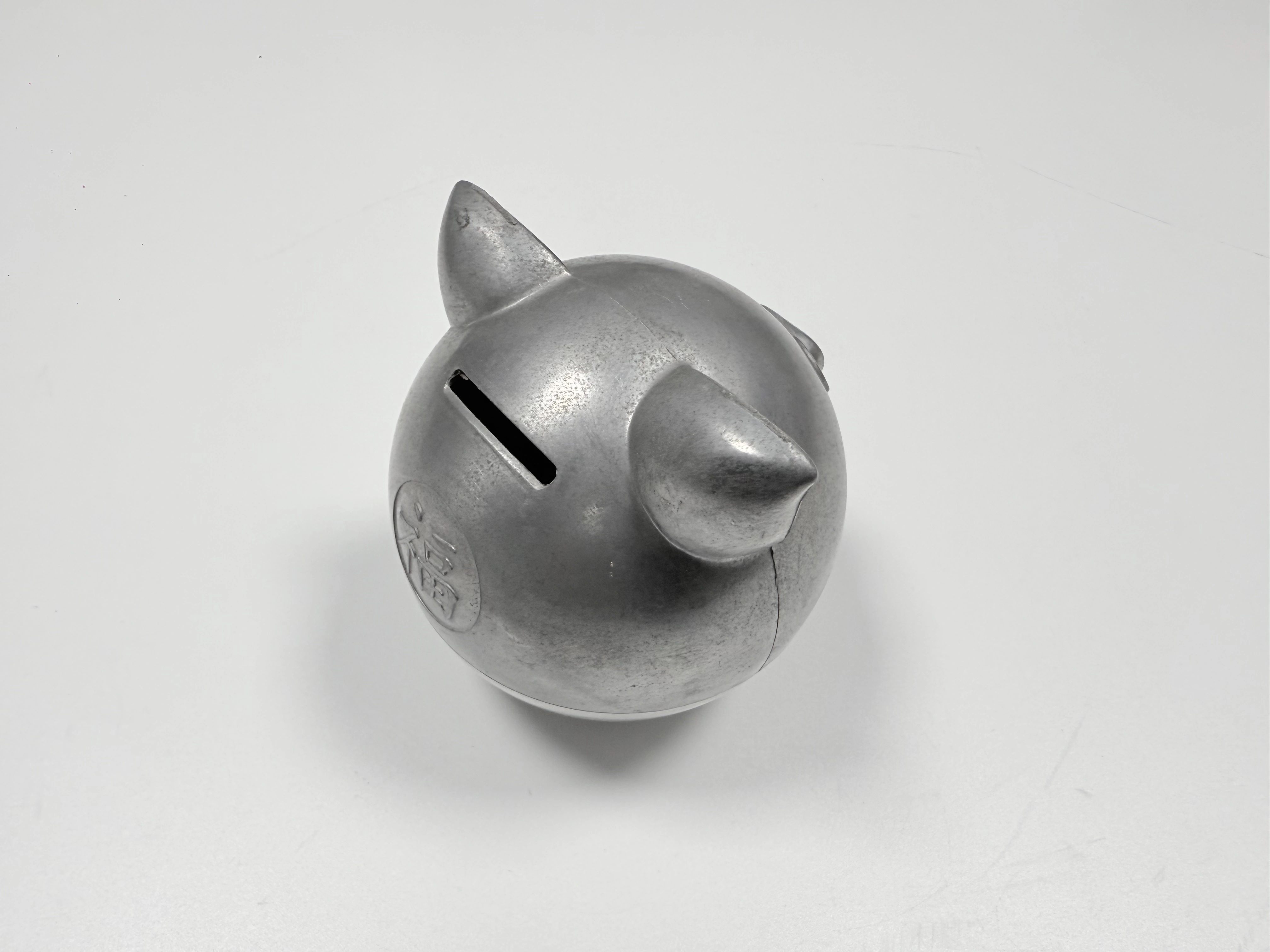
A roly-poly bank returns upright because its mass sits low, not because the part is heavy. A zinc die casting shell with a 12 mm zamak weighted base does the work: at 6.6 g/cm³ the alloy packs mass into the bottom section, and the 300±10 g finished weight lands under the rocking surface. Total weight alone explains little.
Mass Low, Center Below the Curve
The bank rocks on a curved bottom. Tilt it and the contact point shifts, the mass rises, and gravity pulls it back. A return happens only while the center of gravity sits below the center of the arc, inside the rocking radius. Move that center above the curve and the same tilt becomes a fall.
Dense metal in the 12 mm base section buys that margin at the lowest point of the shell. The 1.2–1.5 mm walls above it add little to the total. Put the same mass higher and the bank gains weight without gaining stability.
Center of Gravity, Not Total Weight
The 300±10 g figure is a budget, not a target to chase upward. Where that mass sits matters more than how much there is. Weight in the base lowers the center; weight in the shell raises it and eats the margin for a return. The Zamak 5 alloy at 6.6 g/cm³ makes that base-weighted layout practical, because a 12 mm section carries real mass without a thicker wall behind it.
Two parts can both sit inside that band and behave differently. The one with mass at the bottom rights itself from a harder push. The one with a heavy upper shell may look fine on a shelf and still fail the tip test. Judge the center, then the total.
Parameter | Value | Unit | What it fixes |
|---|---|---|---|
Base section | 12 | mm | Mass at the lowest point |
Wall above base | 1.2–1.5 | mm | Keeps mass low |
Finished weight | 300±10 | g | Total budget |
Alloy density | 6.6 | g/cm³ | Mass per volume |
Loaded test | 200 | coins | Worst-case fill |
Tip test | 20 | ° | Return check |
Why the Base Is Cast, Not Inserted
The base is cast in the same shot as the shell, in Zamak 5 to ASTM B86 AC41A. No steel slug sits inside it and no pocket waits for one. An inserted weight needs a cavity to hold it and a way to keep it from shifting, which adds a tolerance chain between insert and shell. Each of those is a place where balance drifts.
One shot also keeps the mass where the drawing puts it. The 12 mm zamak weighted base is a die feature, so every part inherits the same geometry and the same density. A separate weight can sit a little high or a little low, and a bank that passed on the bench may not pass in the next run. Casting removes that variable at the source.
What Coin Load Does to Balance
An empty bank is the easy case. Drop 200 coins through the slot and they settle above the base, which lifts the combined center of gravity. The base still has to bring the loaded shell back. A thin base and a heavy upper shell start to lean and stay leaned.
The check is specified at 200 coins for that reason. Coins pile where they land, so the load does not form a neat ring at the bottom. Some sit higher than others, and the center moves with them. A bank that returns with 200 coins inside has margin for the way a real bank gets filled; one that returns only when empty has none.
How the Check Is Run
Place the bank on a flat surface, tip it to 20°, and let go. A correct part rocks past the release point, pauses, and comes back upright. Repeat the run empty and again with 200 coins inside. An empty pass is not a pass, because the empty run leaves out the mass that will sit above the base.
Log the angle, the load, and the result on the inspection sheet. A 20° push is a check, not a claim about how hard a child will push the bank. The angle gives a repeatable input that separates a part with margin from one that barely returns.
Add these lines to the drawing: base section 12 mm, finished weight 300±10 g, and a 20° return test with 200 coins inside. Then confirm the base seat after CNC machining, because a cut that runs deeper than the drawing takes mass off the lowest point.