Zinc Die Casting vs Aluminum Die Casting: Which Process Is Better for Your Custom Parts?
Neither zinc die casting nor aluminum die casting is better for every custom part. Zinc is often the stronger candidate for a compact, detail-dense component when mass is acceptable and plating, thin local features or long-running small-part tooling matter. Aluminum is often the stronger candidate when low mass, a larger structural envelope, heat transfer or elevated service temperature drives the design. The final choice must be made with a named alloy, production geometry, finish route and acceptance plan, not with the words zinc and aluminum alone.
Start with the custom part, not a material contest
A buyer should first define the job the casting performs. Record the installed mass limit, load cases, stiffness or deflection limit, operating and peak temperatures, heat-flow path, corrosion media, electrical behavior, cosmetic zones and expected wear. Add the part envelope, annual demand, production life, mating parts and every dimension that controls assembly. These requirements reveal which differences between the two processes actually matter.
Do not compare a zinc version and an aluminum version at identical geometry by default. Their different density, stiffness, castability and process route may justify different walls, ribs, bosses, radii and fastening concepts. The fair comparison is between two production-feasible designs that meet the same product requirements. A competent design review should therefore examine material and geometry together.
Name the alloy and casting route
Zinc and aluminum are families, not complete specifications. Zamak 3, Zamak 5 and other zinc choices differ in mechanical behavior, dimensional stability, finish response and commercial availability. Aluminum choices such as A380, A360, A413 or ADC12 also differ in castability, corrosion behavior, pressure-tightness tendency, machinability and strength. The appropriate standard and condition must be stated on the drawing or purchase specification.
Most zinc high-pressure parts are produced by a hot-chamber route, where the injection system operates with the molten alloy. Aluminum high-pressure die casting generally uses a cold-chamber route because of its process temperature and interaction with injection components. This distinction affects machine layout, shot handling, cycle economics and tooling exposure. It does not, by itself, guarantee the quality of a specific part.
Use the Zamak alloy selection guide and the aluminum alloy comparison to make separate shortlists. Then ask the foundry to confirm availability, metal-control method, recyclate policy where specified and the evidence used to verify the supplied chemistry.
Use requirement gates before detailed costing
Requirement gate | Zinc direction | Aluminum direction | Evidence before selection |
|---|---|---|---|
Strict finished mass or large envelope | Higher density may reject the route unless geometry can shrink substantially | Lower density usually supports the objective | Mass from production-feasible CAD, including inserts and finish |
Dense small features and compact mechanisms | Often favorable when the hot-chamber tool can fill and release the geometry | Possible, but local filling and ejection need independent proof | Flow/thermal review, trial parts and feature capability study |
Heat-spreading enclosure or finned housing | Usually not selected for primary thermal duty | Common candidate, subject to alloy and thermal-interface design | Thermal model and assembly-level temperature test |
Bright decorative metallic finish | Often supports a controlled polish and plating route | Possible through a different preparation and finish system | Production-intent limit samples and complete finish validation |
Elevated sustained temperature | Requires alloy-specific creep and dimensional review | Often the broader starting candidate, still condition-dependent | Load-temperature-time test on representative parts |
Very high demand for a compact part | Tool thermal loading and hot-chamber productivity may be favorable | Economics depend on cavity count, cycle, die maintenance and yield | Capacity model and accepted-part cost for the intended production life |
A gate is not a marketing scorecard. If mass is decisive, an otherwise attractive zinc route may leave the shortlist. If metallic appearance and tiny integrated mechanisms dominate while mass is immaterial, zinc may deserve the first tool concept. When no gate decides the outcome, carry both routes into parallel DFM and costing.
Compare mass on redesigned parts
Zinc is substantially denser than aluminum, so an equal-volume zinc part is heavier. That simple statement is useful but incomplete. Zinc castability may permit local section reduction or feature integration, while an aluminum design may need a different rib pattern or larger section to meet deflection and filling needs. CAD mass should come from each supplier's feasible geometry, not from multiplying the same model by two density values.
Mass matters differently by product. It can affect vehicle energy use, handheld comfort, installation, shipping, hinge load or drop behavior. In a small knob, latch or connector shell, extra grams may be irrelevant or may create a desired feel. State the actual system consequence so the material decision does not become an abstract lightweighting exercise.
Separate strength, stiffness and damage modes
There is no defensible statement that zinc is simply stronger or aluminum is simply stronger. Compare the named alloys at relevant temperature and condition, then assess the finished geometry. Yield, ultimate strength, elongation, hardness, fatigue, creep, impact and elastic modulus describe different behavior. Casting skin, porosity, sharp transitions, machined exposure and coating also affect where failure begins.
For a bracket, load path and deflection may control before material strength. For a threaded boss, pull-out, local bearing and assembly torque may control. For a latch, wear, impact and dimensional stability may matter more than tensile data. Validate the likely failure mode with production-intent specimens or complete parts, using load direction, fastener, temperature and duty cycle that represent service.
Small complex geometry often favors zinc, conditionally
Zinc is frequently shortlisted for small components with fine ribs, slots, lettering, thin local sections, compact bosses and tightly grouped functional features. Its filling behavior and hot-chamber process can support high feature density. That advantage remains conditional on gate-to-vent flow, die temperature, venting, parting, draft, ejection and tool access. A feature that can fill but cannot release or be maintained is not production-ready.
Do not attach a universal minimum wall or tolerance to the material name. Wall feasibility changes with flow length, alloy, projected area, local thermal mass and machine. Accuracy changes with dimension size, parting plane, slide travel, die temperature, cooling, ejection and measurement state. The zinc design guidelines should be converted into a feature-by-feature DFM record for the actual tool.
Larger lightweight and thermal parts often favor aluminum
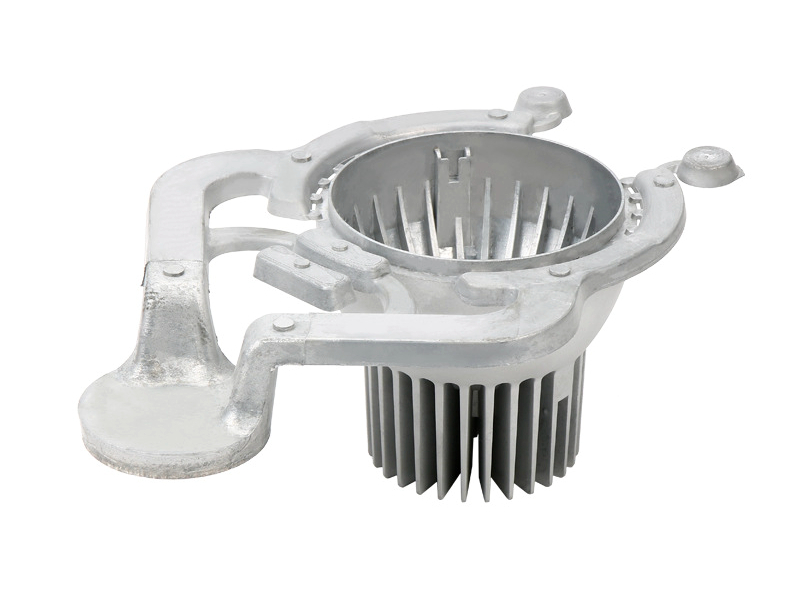
Aluminum is commonly selected for housings, covers, brackets, frames and heat-spreading structures where a zinc version would carry unnecessary mass. Aluminum die casting can consolidate ribs, bosses, mounting lands and enclosure walls into one part. Its suitability still depends on filling a large projected area, managing distortion, controlling porosity at machined or sealing zones and designing ejection without damaging broad faces.
Thermal conductivity is alloy- and condition-dependent, and thermal performance is a system result. Fin thickness, base thickness, interface flatness, airflow, contact resistance, coating and heat-source attachment may dominate. Require a thermal model and an assembled temperature test rather than choosing aluminum from a conductivity table alone.
Temperature can eliminate a candidate
Service temperature should include normal operation, transient peaks, nearby heat sources, cleaning cycles and storage. Zinc alloys can lose load-bearing capability or accumulate creep in conditions that appear moderate when only room-temperature tensile data are reviewed. Aluminum is often considered for higher-temperature structures, but its alloy properties and distortion also change with temperature.
For a loaded boss, spring seat or clamped flange, evaluate stress, temperature and time together. Test dimensional recovery, fastener preload or functional position after the intended exposure. A vague label such as heat resistant is not an acceptance criterion.
Dimensional accuracy belongs to the feature and datum scheme
Zinc can offer favorable repeatability on compact detail-dense parts, yet neither process makes every dimension equally capable. Dimensions within one die half behave differently from those crossing a parting line or slide. A thin opening near the last-fill region has different risk from a supported boss near the gate. Large aluminum panels may be controlled by flatness and residual stress rather than a small linear dimension.
Mark functional characteristics, datum references, measurement state and mating consequence. Decide which remain as-cast and which need post machining. Then ask for a tolerance assessment tied to tool construction, cooling, trim, finish and inspection fixture. A blanket tolerance on the title block can cause needless machining or an unmeasurable requirement.
Porosity is a location and function question
Both zinc and aluminum pressure die castings can contain gas or shrinkage porosity. The relevant question is whether discontinuities intersect a sealing land, thread, highly stressed section, cosmetic finish or machined surface. Aluminum structural and pressure-containing parts often receive particular scrutiny because their larger geometry and machining plan can expose internal pores. Zinc polishing and plating can also reveal pores that were hidden under the cast skin.
Define prohibited zones and inspection evidence. Depending on risk, evidence may include process monitoring, visual inspection, leak testing, radiography, sectioning, density comparison or machining trials. No single method detects every defect or proves function. Select inspection from the failure mode and qualification stage.
Surface finish can change the process choice
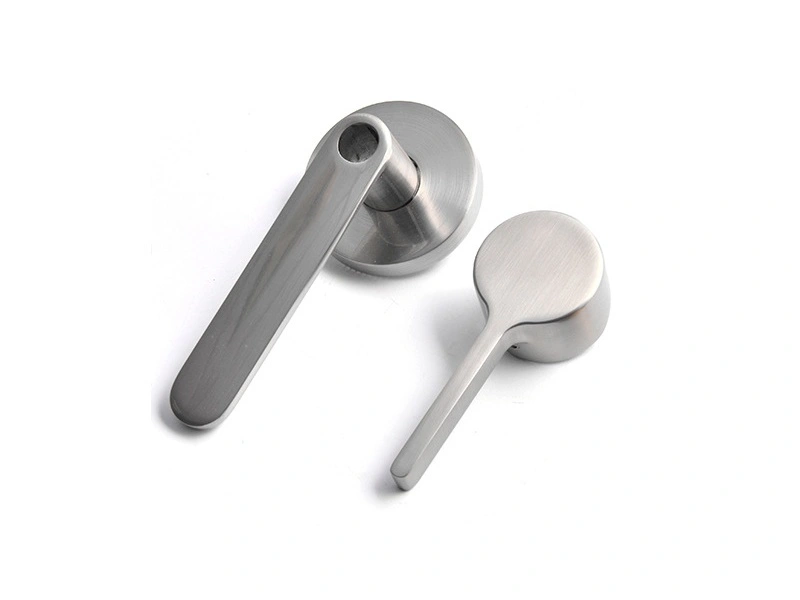
Zinc is well established for polished and plated decorative hardware, provided the substrate is dense, cosmetic witnesses are controlled and the complete plating stack is qualified. Aluminum supports painting, powder coating, conversion treatments and anodizing-related routes, but alloy chemistry and cast microstructure influence appearance. Neither substrate should be promised a flawless finish without production-part samples.
Compare total routes, including trimming, grinding, polishing, cleaning, pretreatment, layers, cure, masking, rack marks, dimensional effect and rejected-part timing. The zinc finishing guide and aluminum finishing guide frame different substrate risks. A topcoat name alone cannot make the routes equivalent.
Tool concepts must be compared separately
Zinc's lower process temperature often reduces thermal fatigue relative to aluminum, which can support long die service for suitable compact parts. This is a directional economic advantage, not a guaranteed die-life number. Slides, slender cores, abrasive features, gate erosion, cavity count, cooling design, steel, heat treatment and maintenance practice can govern actual life.
Request a tool concept for each route: cavity count, parting, gate/overflow layout, slides, replaceable inserts, cooling, ejection, trim, shot capacity, expected maintenance and ownership. The tooling cost guide helps structure the comparison. A lower initial quote can lose value if it assumes fewer cavities, manual trim or no replacement strategy for a wear-prone core.
Compare total cost per accepted finished part
Raw alloy price is only one cost input, and price per mass unit is especially misleading when the candidate designs have different mass. Build the model from metal per shot, runner return policy, cycle and cavities, machine rate, labor, yield, tool amortization, maintenance, trim, machining, finish, inspection, packaging and freight. Include loss at the stage where a defect is found; a casting rejected after plating carries more added cost than one rejected after trim.
Cost block | Question for zinc quote | Question for aluminum quote | Comparable output |
|---|---|---|---|
Tool and capacity | Hot-chamber machine, cavities and maintenance assumptions? | Cold-chamber machine, shot capacity, cavities and maintenance assumptions? | Amortized cost and available annual capacity |
Casting conversion | Cycle, trim and expected stable yield for proposed geometry? | Cycle, spray/cooling, trim and expected stable yield? | Conversion cost per accepted casting |
Secondary route | Polish, plate, machining and inspection scope? | Machining, leak control, coating and inspection scope? | Finished-part cost at the same acceptance boundary |
Quality loss | Where are cosmetic or plating defects detected? | Where are porosity, distortion or machining defects detected? | Cost and owner of loss by process stage |
System value | Can feature integration remove purchased components? | Can lower mass or thermal function remove system cost? | Total assembled-product impact |
Use realistic volume scenarios rather than a single lifetime forecast. A program may have launch, mature and decline phases, plus service demand. The die-cast cost guide can organize assumptions, but the decision still needs supplier quotes based on the two feasible designs.
Prototype the risk, not only the shape
A machined prototype can verify envelope and assembly but does not reproduce die-cast skin, porosity, draft, ejection, gate trimming or production finish response. Use prototypes to answer the question they can represent. If weight and hand feel are uncertain, make physical mass-representative models. If thermal behavior drives aluminum selection, test the intended interfaces and airflow. If plating appearance drives zinc selection, use cast production-intent samples as soon as practical.
Before production tooling, record which assumptions remain unverified. Flow and thermal simulation can compare gate concepts but still requires trial evidence. Tool samples should be evaluated after trimming, machining, finish and assembly, because a material can appear acceptable at casting release and fail at a later boundary.
Run parallel DFM when the choice is close
Provide the same neutral requirement package to zinc and aluminum specialists. Permit each to propose geometry changes, but require a marked-up model and assumption list. Compare mass, functional compliance, tooling concept, capacity, secondary operations, inspection and cost. Do not ask suppliers to price an unchanged model that was designed around the other alloy and then treat the quotes as a fair process comparison.
Close decisions benefit from a simple risk register. Identify what could overturn the selection: aluminum distortion at a sealing flange, zinc mass above the product limit, plating pits at a visible face, machining that opens pressure-leak porosity or tool maintenance that constrains capacity. Assign an owner, evidence and due date before tool authorization.
Normalize commercial assumptions before comparing totals. Both quotes should use the same currency basis, annual demand, program life, acceptance state, packaging destination and ownership of rejected work. Record whether alloy escalation, maintenance, inspection fixtures and finish qualification are included. A visible price gap can disappear when one proposal ends at trimmed casting and the other ends at inspected, coated and packed parts.
RFQ inputs for a defensible comparison
Neutral CAD, assembly context, mating components, datums and function-sensitive dimensions.
Mass target, load cases, stiffness/deflection, impact, wear, temperature-time profile and thermal duty.
Corrosion media, contact metals, electrical requirements, visible zones and complete finish expectation.
Annual demand scenarios, program life, service demand, ramp timing and required capacity evidence.
Allowed alloy standards, restricted substances, traceability and material verification.
Machining, sealing, leakage, cleaning, assembly, inspection, packaging and change-notification boundaries.
Tool ownership, cavities, spare inserts, maintenance, sampling, approval and end-of-program obligations.
Ask each supplier to return a DFM disposition, named alloy, revised feasible mass, process route, control plan outline, validation plan and itemized quote. The buyer owns service requirements and product acceptance. The casting source owns the manufacturability proposal and process evidence within its scope. Unsupported category claims should not substitute for either responsibility.
Final decision rule
Choose zinc when a named zinc alloy and hot-chamber tool concept best meet the compact part's detail, finish, dimensional and production-life needs without violating mass or temperature limits. Choose aluminum when a named aluminum alloy and cold-chamber route best meet mass, structural-envelope, thermal or service-temperature requirements with controlled distortion, porosity and secondary operations.
If both remain viable, select the production-feasible design with the lower total risk-adjusted cost per accepted assembled part. Preserve the losing route's evidence in the decision record; a future volume, finish, load or geometry change may alter the answer. That is a more useful engineering conclusion than declaring either metal universally better.
Frequently Asked Questions
What are the main differences between zinc die casting and aluminum die casting?
When should manufacturers choose zinc die casting instead of aluminum die casting?
Which process offers better dimensional accuracy for small complex parts?
How do zinc and aluminum die castings compare in strength and weight?
Which die casting process is more cost-effective for high-volume production?