How do zinc and aluminum die castings compare in strength and weight?
Zinc die castings are heavier at the same volume, while aluminum die castings generally provide a much lower part mass and therefore a better starting point for weight-sensitive structures. Strength has no single winner. A named zinc alloy may suit compact hardware with local load, wear and solid feel; a named aluminum alloy may carry the required load in a lighter housing or bracket. Compare redesigned parts by failure mode, not equal-volume coupons.
Weight is the clearer comparison
Zinc has higher density than aluminum. If two parts occupy the same volume, the zinc part weighs more. This difference matters for a moving assembly, vehicle, handheld product, shipping limit or large enclosure. It may be insignificant for one small latch, or desirable where the customer expects a substantial feel.
Calculate weight after separate DFM. Zinc may permit local section reduction and feature consolidation; aluminum may need a different rib layout to meet stiffness and casting stability. Include inserts, fasteners and finish because the installed product, not the bare CAD shell, carries the requirement.
Strength is not one property
Design question | Relevant behavior | Material-selection implication | Verification |
|---|---|---|---|
Will a bracket permanently bend? | Yield, section shape and stress concentration | Compare named alloys in feasible geometries | Load test and permanent-set measurement |
Will alignment move under load? | Elastic modulus, span, ribs and joint stiffness | Geometry may dominate tensile strength | Deflection test in assembly |
Will a boss retain a fastener? | Local bearing, thread engagement, porosity and torque | Compact zinc or lightweight aluminum can both work | Torque, pull-out and repeat-assembly test |
Will a latch survive cycles? | Wear, impact, fatigue and dimensional drift | Zinc may suit compact mechanisms; condition decides | Duty-cycle test with actual mating parts |
Will a loaded part hold position when hot? | Creep, temperature-dependent strength and joint preload | Aluminum often deserves first review at higher temperature | Load-temperature-time conditioning |
Compare stiffness separately from strength
A part can remain below yield and still deflect too far for a gear mesh, optical alignment, gasket or switch. Stiffness depends strongly on section geometry and span. Rib height, wall orientation, closed sections and fastening points can matter more than a small difference in material strength.
Aluminum's low density gives designers room to add section depth while keeping mass controlled. Zinc can package a stiff compact shape in a small envelope, but its weight rises quickly as volume increases. Use structural analysis to compare feasible geometries and verify boundary conditions with an assembly test.
Zinc often fits compact local loads
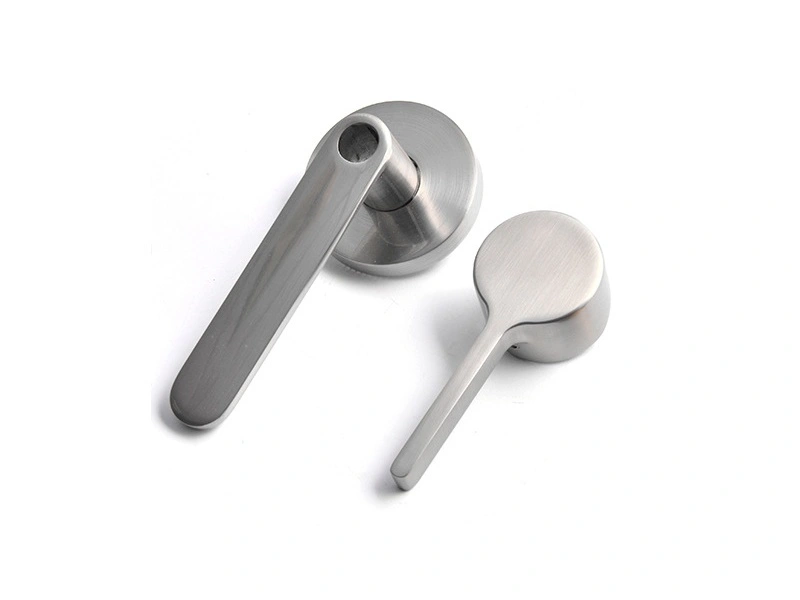
A zinc part may be attractive for a lock component, handle base, small gear housing or connector shell where the loaded path is short and detailed bosses, stops or pivots can be integrated. Its higher mass is often acceptable at this scale. Surface hardness, wear pair and finish may also affect function.
This is not permission to assume zinc is stronger. Select Zamak 3, Zamak 5 or another grade from the required behavior and availability. Check thin ligaments, sharp internal corners, parting features and pores at machined holes. The zinc process route must support the proposed geometry and inspection.
Aluminum often fits lightweight structural envelopes
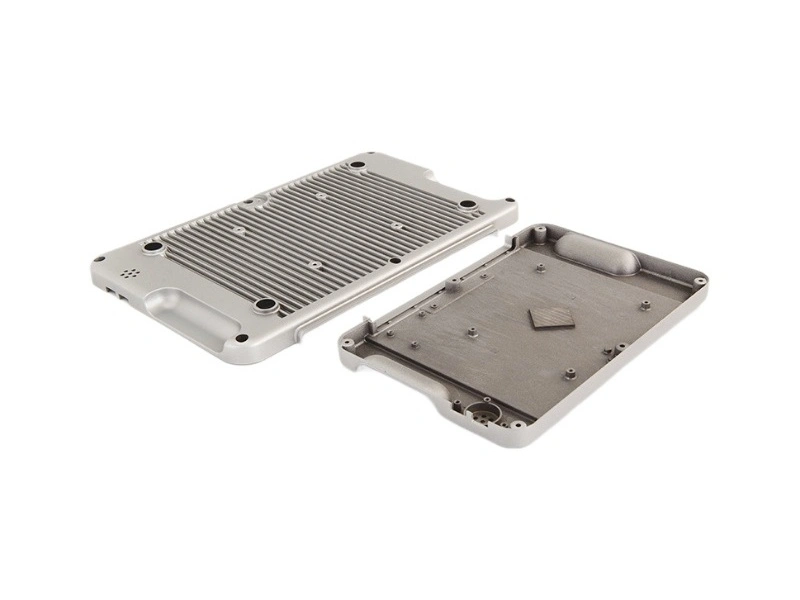
Aluminum commonly serves larger covers, frames, brackets and housings because the product can occupy a broad envelope without the mass of zinc. Different aluminum die-casting grades balance castability, corrosion, mechanical behavior and machining differently. A380, A360, A413 and ADC12 should not be approved as equivalent without a requirement review.
Large aluminum castings need attention to load path, distortion, porosity, trim and machining. Low density does not guarantee a light finished design if walls are made unnecessarily thick or if added steel brackets compensate for poor integration. Review the aluminum die-casting route with the complete assembly.
Temperature can reverse room-temperature conclusions
Mechanical data at room temperature do not establish performance near a motor, lamp, engine compartment or heated process. Zinc requires particular scrutiny for time-dependent deformation under sustained load as temperature rises. Aluminum also loses strength with temperature, and the degree depends on alloy and condition.
Define normal and transient temperatures, dwell time, load and allowed movement. Condition the final geometry and repeat torque, deflection, alignment or sealing checks. If the component experiences thermal cycling, include joint expansion and coating behavior.
Casting quality affects real strength
Gas porosity, shrinkage, cold shuts, cracks and oxide-related discontinuities can reduce effective section or create initiation sites. Their importance depends on location. A pore in a low-stress cosmetic area is not equivalent to a discontinuity at a machined thread root or highly loaded rib junction.
Map function-sensitive zones and choose inspection accordingly. Process monitoring, sections, radiography, machining trials, leak checks or proof loads answer different questions. Do not use a generic porosity grade as a substitute for a functional acceptance plan.
RFQ inputs for strength and weight
Installed mass limit and why it matters to the product.
Static, cyclic, impact and assembly loads with directions and restraints.
Deflection, permanent set, wear and life endpoints.
Temperature and time profile, including transients and cleaning.
Named or permitted alloy standards and material verification.
Machined zones, surface finish, joints and function-sensitive defect limits.
Use part-and-assembly design review to generate one feasible zinc concept and one feasible aluminum concept. The better choice is the lighter design that meets function when mass controls, or the lower-risk compact design when mass does not. Strength must be demonstrated by the relevant complete-part test in either case.