What are the main differences between zinc die casting and aluminum die casting?
The main differences are process route and design priority. Zinc high-pressure die casting commonly uses hot-chamber equipment and is often favored for compact, detail-dense parts, plated cosmetic surfaces and long-running small-part tools. Aluminum high-pressure die casting uses a cold-chamber route and is often favored for lower mass, larger housings, heat-spreading structures and higher service temperatures. Neither choice guarantees strength, accuracy or lower cost without a named alloy and part-specific DFM.
Compare alloy families, not metal names
Zamak 3 and Zamak 5 are not interchangeable labels, and A380, A360, A413 and ADC12 do not have identical behavior. Alloy chemistry affects casting response, mechanical properties, corrosion, machining and finish. The drawing should identify an applicable grade and standard, or clearly permit supplier alternatives subject to engineering approval.
Begin with the zinc die casting and aluminum die casting routes, then ask each supplier to name the candidate alloy and explain why it suits the failure mode. Category averages cannot release a production part.
Hot- and cold-chamber routes change production
In a hot-chamber zinc machine, the injection system operates with the molten metal, supporting a production pattern well suited to many small components. Molten aluminum is normally ladled or dosed into a cold chamber before injection because its temperature and interaction with immersed components require a different arrangement. This changes shot handling, machine selection, thermal load and cycle assumptions.
The route is an economic input, not a quality verdict. Cavity count, shot size, runner, cooling, spray, trim, automation, maintenance and stable yield determine usable capacity. Ask for these assumptions rather than accepting a general statement that one cycle is faster.
Density and envelope separate many projects
An equal-volume zinc component weighs more than an aluminum component. For a large frame, handheld device or moving assembly, that mass difference can decide the shortlist. For a small lock pawl, knob or connector shell, it may have little consequence or may contribute a desired feel.
Compare redesigned feasible parts, not one unchanged geometry. Zinc may support local feature integration or section changes; aluminum may use a different rib and wall layout to meet stiffness and filling. Calculate finished mass from each DFM model, including inserts and coating.
Geometry and dimensions have different risk patterns
Decision area | Zinc tendency | Aluminum tendency | Required evidence |
|---|---|---|---|
Small integrated detail | Often favorable for fine local features | Feasible when flow, release and tool construction support it | Feature-level DFM and trial capability |
Large broad housing | Mass can become a penalty | Common route, with distortion and filling controls | Flow/thermal review, flatness and assembly study |
Dimension across parting or slide | Tool interfaces affect repeatability | Tool interfaces affect repeatability | Datum-specific tolerance analysis |
Machined seal or thread | Machining can expose pores | Machining can expose pores | Stock, porosity-zone and functional test plan |
Zinc often has a practical advantage for compact accuracy, but no universal wall or tolerance applies. Aluminum may be entirely capable on a small part, while zinc may fail a particular cross-slide dimension. Use drawing characteristics, datums and final measurement state to define the comparison.
Mechanical and temperature behavior need separate tests
Strength, stiffness, fatigue, impact, hardness and creep are separate attributes. Zinc can perform well in compact loaded hardware when its mass and temperature are acceptable. Aluminum often provides a better route for lightweight structures and sustained elevated-temperature service. The actual result depends on alloy, porosity, geometry, load direction and condition.
Test the likely failure mode on a representative part. A fastened boss needs preload or pull-out evidence. A bracket needs load and deflection. A latch may need wear and impact. Room-temperature tensile data alone cannot settle those product questions.
Thermal and surface needs point in different directions
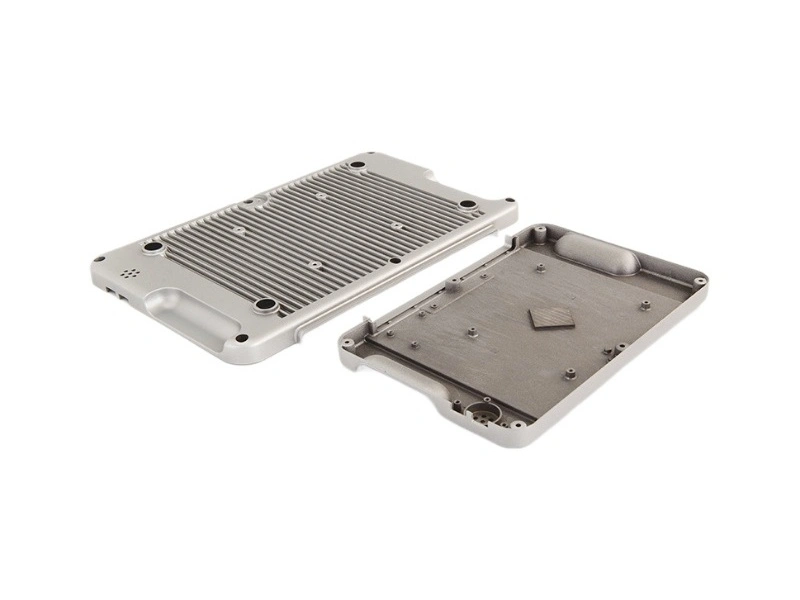
Aluminum is commonly chosen for heat sinks and heat-spreading enclosures, but alloy conductivity is only one input. Base thickness, fins, airflow, coating and interface resistance must be modeled and tested. Zinc is rarely selected for primary thermal duty, though it can still serve near electronics where heat transfer is not the controlling function.
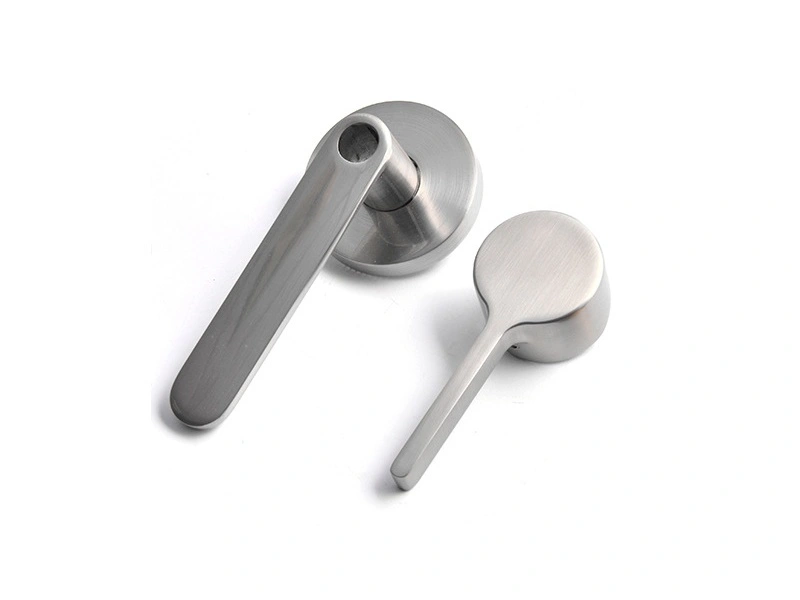
Zinc often supports polished decorative plating on compact visible hardware. Aluminum supports paint, powder, conversion and anodizing-related systems, with appearance influenced by alloy and cast microstructure. Qualify the complete substrate-to-finish route on production-intent parts; do not infer finish quality from the metal name.
Tooling and cost require two models
Zinc's lower process temperature can reduce die thermal fatigue, but slides, cores, gate erosion and maintenance may still govern tool life. Aluminum tooling sees a different thermal cycle and may require different cooling and maintenance. Obtain separate cavity, machine, trim and spare-insert concepts.
Cost should include alloy per shot, cycle, cavities, stable yield, die maintenance, machining, finishing, inspection and freight. Lower density can create system value for aluminum; feature consolidation and tool life can create value for zinc. The lowest raw-material quote is not necessarily the lowest delivered cost.
Buyer decision checklist
Name alloy candidates and applicable standards.
Compare DFM-adjusted mass, not identical geometry.
Map loads, temperature, heat flow, corrosion and visible surfaces.
Mark as-cast and machined dimensions with datums and final state.
Compare tool concept, capacity and complete accepted-part cost.
Validate casting, finish and assembly on production-intent samples.
The main difference is therefore not a one-line property ranking. Zinc generally leads the shortlist when compact detail and finish dominate; aluminum generally leads when mass, envelope, heat or temperature dominate. A parallel design review provides the evidence to decide when those signals conflict.