Zamak 5 for Bezel Rings: Density, Plateability, Press Fit
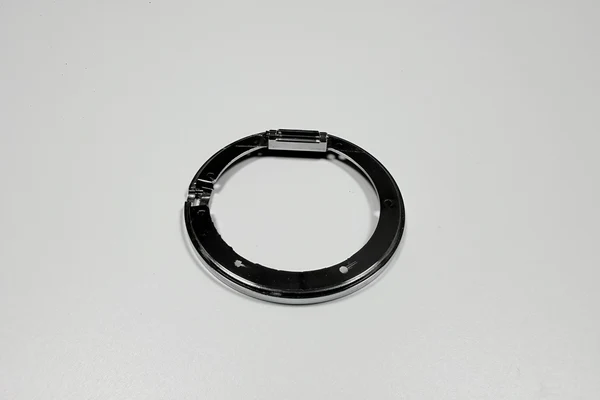
Zamak 5 suits a Ø35 mm bezel ring because three properties line up: it casts a 1.8 mm wall without freezing early, it takes 18–27 µm of copper, nickel and chrome, and it holds a press fit after plating. The grade is listed as zinc alloy stock and specified to ASTM B86 AC41A in the cast state.
Those three properties are also the limits. Zamak 5 is a decorative alloy with a soft core, and every number below is about what it can and cannot carry. The ring weighs 4.5±0.5 g, so there is little metal to trade for strength.
Why does Zamak 5 suit a 4.5 g bezel ring?
Because the ring is a shape, not a structural member. Its job is to hold the crystal and look finished, and both jobs favour a metal that fills a thin section in one shot rather than one that survives impact.
Zamak 5 also plates well. Zinc accepts copper, nickel and chrome in the standard three-layer stack, and the layers bond to a casting skin that is dense when the tool is right.
A heavier alloy would cost more per ring without making it better at either job. The 4.5 g budget is met by the casting itself, not by a secondary machining operation that removes metal.
What does the density mean for a Ø35 ring?
Density converts the ring's volume into the weight the customer feels. Zamak 5 sits at about 6.6 g/cm³, a typical value for the alloy, so a ring of this diameter and height lands near 4.5 g when the wall runs 1.5–1.8 mm.
The number matters at the drawing stage, not at the scale. Design the wall thicker and the ring gains weight; design it thinner and the casting stops filling before the metal reaches the far side.
It also sets the comparison with stainless. A turned stainless ring of the same size weighs more than twice as much, which is one reason a bezel ring is cast in the first place.
Which Zamak grade fits a pressed bezel?
Zamak 5 is the common choice for a pressed bezel because it balances castability and strength better than the lower grades, and it plates in the same lines as the rest of the family.
The grade is not a free choice at the end of the project. Changing from one Zamak grade to another changes the casting temperature, the shrinkage and the plating response, so it reopens the first article.
A drawing should name the grade and the standard together. Naming only "Zamak" leaves the foundry to pick a grade, and the pick may be the one that casts easiest rather than the one that plates best.
What does ASTM B86 AC41A fix?
It fixes the alloy family, the casting state and the impurity limits that matter for plating. A ring bought to AC41A is bought to a known composition rather than to a trade name.
The standard also gives the buyer a reference when a lot behaves differently. If a batch plates with blisters or machines with a different chip, the first question is whether the metal met the specification.
For the drawing, the practical result is one line: Zamak 5 to ASTM B86 AC41A, cast state. Everything else about the ring is geometry and finish.
Why does plating hold on Zamak better than on aluminum?
Because zinc is closer to the plating sequence chemically, and the standard three-layer stack was built around zinc die castings. Copper strikes on zinc, nickel builds on copper, and chrome finishes the surface.
Aluminum needs a zincate step before plating, and that extra step is another place for adhesion to fail. The layer structure is described in the electroplating notes.
Zinc has its own weakness, which is porosity. A pore that reaches the surface holds plating solution and blisters later, so the casting side of the job is to keep the skin dense enough for the coating to sit on.
Where does a Zamak ring fail under wear?
At the edges and at the contact points: the crown cutout, the inner step where the crystal presses, and the outer diameter where the ring meets the case. Those are the places where the 18–27 µm coating is thin or interrupted.
Chrome is only 0.1–0.3 µm, so it protects against light abrasion and not against a scrape. Once the chrome is cut through, the nickel under it corrodes and the ring shows a dark line.
Sweat and friction do the rest over time. A decorative bezel is designed for that service; a ring that is worn against stone or used in salt water is outside the alloy's intended duty.
Can Zamak 5 hold 0.05 mm roundness after plating?
Yes, but the roundness comes from turning rather than from the alloy. The ring is turned after polishing and before plating, and the circle is generated by the machine on a wall that the chuck does not deform.
Plating does not change roundness in any meaningful way; it adds a uniform layer and follows the shape underneath. What plating changes is the size, which is why the bore is cut to a pre-plate allowance.
The alloy's contribution is castability. A grade that fills the 1.8 mm wall cleanly gives the turning operation a stable ring to hold, and a ring with a cold shut gives it a spring that moves under the tool.
What does 18–27 µm do to the press fit?
It closes it. The coating lands on the bore and on the outer diameter, so the interference of 0.02–0.05 mm is consumed from both sides, and the pre-plate size has to leave room for the coating.
This effect is large enough to decide the assembly. Across a diameter the coating adds 0.036–0.054 mm, which is wider than the whole interference band, so a ring cut to the finished size before plating arrives too tight.
The check is a trial press at 200–600 N with the mating case, handled at the post-machining stage. A gauge at the machine reads metal; only the press reads metal plus coating.
When should the ring switch to stainless?
When the service condition crosses the decorative line: a dive rating, long abrasion, or a wall that would have to go below 1.5 mm. At that point the zinc route stops being the cheap route.
Stainless turning takes impact and keeps a brushed finish, and the coin bank case shows the same trade on a different part: the alloy is chosen for the finish and the fit, not for abuse.
The switch is a tooling decision as much as a material one. A zinc ring already in production needs a new tool to become a stainless ring, so the decision belongs before the first cut.
What changes if the ring goes PVD instead of Cu/Ni/Cr?
The colour palette widens and the process changes. PVD deposits a thin film in a vacuum chamber, and it can produce tones that electroplating cannot, which is why a brand may ask for it on a bezel.
PVD is one of the surface finishing options, and its trade is thickness and throwing power. A PVD film is thinner than the 18–27 µm stack, so it follows the polished surface closely and shows every scratch that the plating would have covered.
It also changes the press fit. A thinner coating consumes less of the interference, so the bore allowance is different from the plated version, and the trial has to be repeated for the new coating.
| Property | Zamak 5 | Why it matters for a bezel ring |
|---|---|---|
| Density | 6.6 g/cm³ (typical) | Sets the 4.5±0.5 g weight at Ø35×1.8 mm |
| Casting state | ASTM B86 AC41A | Gives a known composition for plating and machining |
| Coating stack | Cu 8–12 / Ni 10–15 / Cr 0.1–0.3 µm | 18–27 µm total, consumed by the press fit |
| Wear limit | Decorative service | Dive, stone contact and salt water are outside it |
Send the service condition with the drawing. The grade follows from it, and the die casting and plating lines can be quoted against the same condition.
FAQ