
What Is a Bezel Retaining Ring? Zamak Casting and Claw Fit
The bezel retaining ring is a 0.8 mm Zamak 5 band that presses on the crystal and locks into the case wall, so it is a structural part before it is a decorative one. Zinc die casting forms the band and its three inner claws in one shot; every later step protects the fit those claws make.
The part is a ring of Ø26×2.0 mm weighing 1.8±0.2 g, cast in Zamak 5 to ASTM B86 AC41A. Four values carry the assembly: a Ø26.0 0/-0.05 mm outer diameter, a 0.8±0.05 mm wall, a 1.2±0.05 mm claw height on three claws at 120°, and 0.05 mm flatness. All four are drawing targets, not readings from one batch.
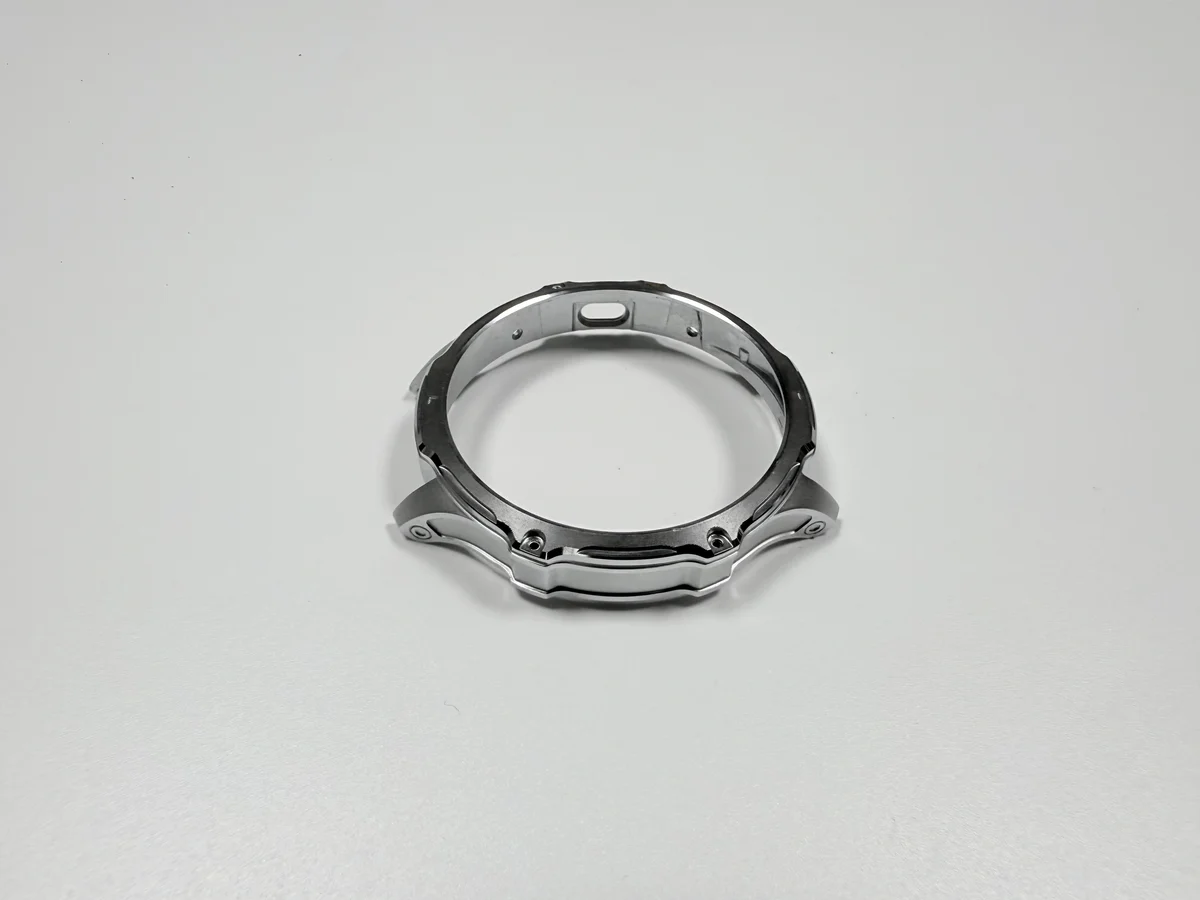
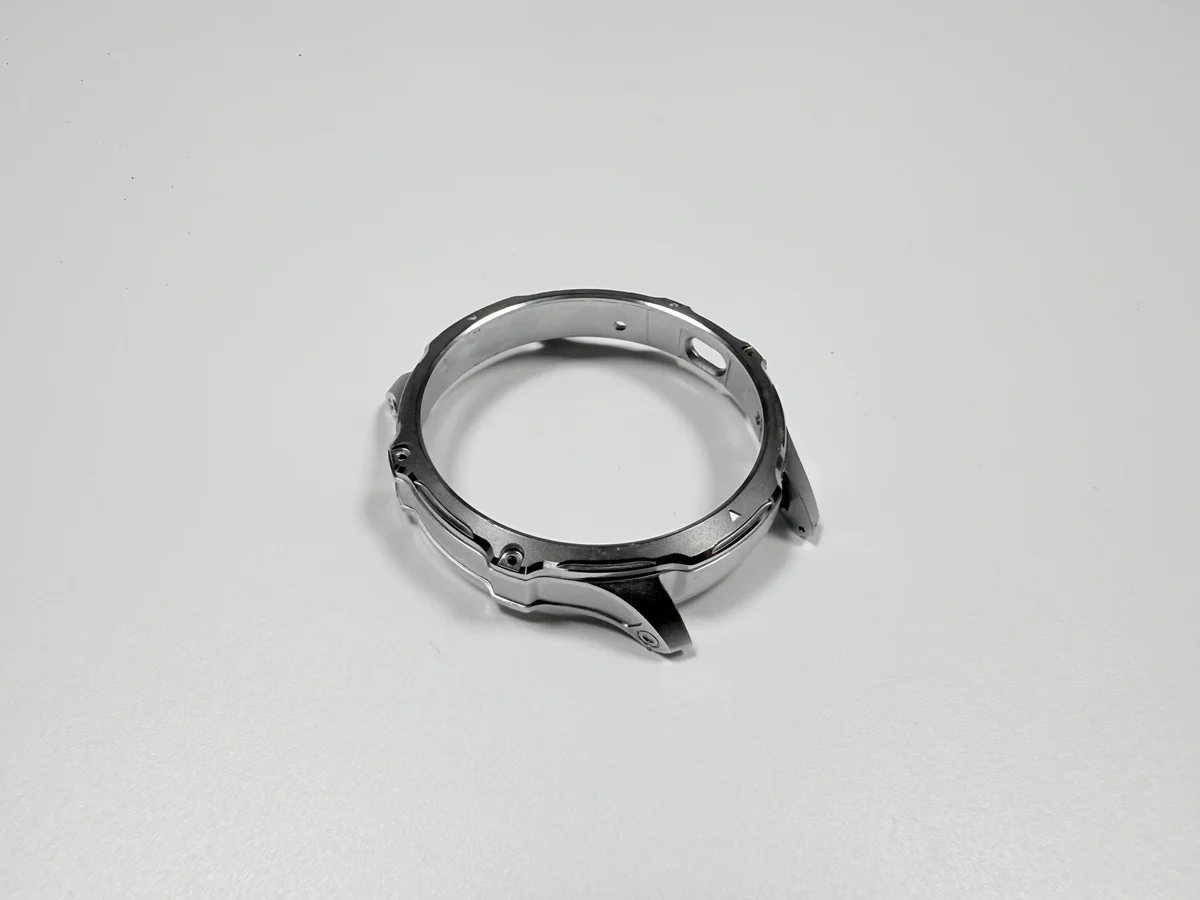
What does a retaining ring hold inside a watch case?
A retaining ring holds the crystal, the gap between crystal and case, and the square seat that aligns both. Three claws press the crystal edge at 120° spacing, so the clamp load arrives at three points, not along a continuous rim.
The outer diameter centers the assembly in the case bore, and the ring base beds on the case floor, which is the datum every reading starts from. It enters in one stroke and is never serviced again. The bore it meets is cut in the watch case middle frame.
Which three features set its tolerance?
Three features set the tolerance: outer diameter, claw height and base flatness; claw position at Ø0.1 mm and wall thickness set strength instead. The outer diameter runs 26.0 mm nominal with the whole 0.05 mm band on the minus side, so a ring may finish small but never large. Claw height is two-sided at 1.2±0.05 mm because the claw touches the crystal from one side only. Flatness at 0.05 mm decides load sharing, since a base that rocks sends the stroke into one claw.
Why cast the ring instead of stamping stainless?
Casting wins where the claw is part of the form and the wall is thin enough that forming costs more than melting. A stamped stainless ring is stronger, yet three inward claws need several draws and the step still needs cutting.
Zinc casts that step near net shape, plates well as cast, and its 6.6 g/cm³ density puts this ring at 1.8±0.2 g. The catch is a fixed tool cost: an eight-cavity 8407 insert with a 500,000-shot design target, spread over the rings that share it. Grade choice is covered under zinc alloys.
Why is a 0.8 mm wall with three claws hard to cast?
A 0.8 mm wall fills only inside a narrow window, and the claws sit at the end of the flow path where metal is coldest. Typical settings are a 400–420 °C melt, a 150–180 °C die, 20–30 MPa and a 15–25 s cycle; outside them the wall shorts or flashes.
Gate and overflow decide where the last metal freezes. A centre gate with the overflow outside the claw roots feeds the root while it solidifies, a design target rather than a trimming fix. Below 0.8 mm the window narrows faster than the weight saving grows, as the thin-wall design guidelines show.
How does claw height decide if the crystal is held?
Claw height is the distance from the ring base to the claw tip, and it is the one dimension here that fails at both ends. At the plus 0.05 the tip lifts the crystal off its seat; at the minus 0.05 it misses the crystal edge.
Trimming the inner claws sets that height after casting, so the die alone cannot hold it. Trim too little and the claw stands high, trim too much and the ring is scrap. Post machining reads it with a height micrometer on every piece, and trimming is priced as its own operation. A quote that folds it into deburring is one line short.
What does plating do to the 26.0 mm fit?
Plating adds metal to every exposed face, and on a one-sided diameter that addition comes out of the fit. Nickel at 3–5 µm per face grows the diameter by 0.006–0.010 mm, and a Cu/Ni/Cr stack of 13.1–20.3 µm per face grows it by 0.026–0.041 mm. Both are worked examples.
Against a 0.05 mm band the three-layer stack spends more than half the allowance. A part cut to finished size before plating arrives at the press too large, so the drawing must say pre-plate or post-plate. Acceptance is a ring gauge, not a trial fit into a case. The same growth shows on a plated case frame.
Why does the inside of the ring plate thin?
An inner cavity plates thinner than an outer face because the cavity shields current; the loss is geometry, not a bath fault. Current density falls in a recess, so the film there drops below the 3 µm acceptance reading first while the outer band still reads 3–5 µm.
Coverage is judged where the interface sits: the claw faces and the inner step, read with X-ray and not by eye. The control sits in the jig, where an auxiliary anode feeds current into the cavity. Jigs are charged per lot, so a 1.8 g ring can carry a plating cost set by the fixture.
Which gauge catches each failure?
Each failure mode has one gauge that proves it, and a caliper proves none of them. Claw height needs a height micrometer read from the base, the outer diameter a ring gauge at Ø26.0 mm, flatness a surface plate and feeler. The press needs a force bench with the mating case, film thickness X-ray, and adhesion a thermal shock run to ASTM B571 and 96 h of salt spray to ASTM B117.
A gauge settles an argument only when its stage is named too. A diameter read after plating includes the coating.
| Interface | Holds | Carrying feature | What proves it | Failure mode |
|---|---|---|---|---|
| Crystal edge | Clamp load at three points | Claw height | Height micrometer | Crystal lifts or point-loads |
| Case bore | Centering and retention | Pre-plate diameter | Ring gauge | Hard or loose seat |
| Case floor | Square bedding | Base flatness | Plate and feeler | One claw takes the stroke |
| Press path | One-stroke seating | Root radius | Force bench | Root cracks at the press |
| Plated faces | Corrosion and appearance | Cavity current | X-ray reading | Bare plating in the cavity |
When does a retaining ring fail in service?
The ring fails when the case stops being a dry, closed housing, or when a repair asks it to come out and go back in. It serves in the case cavity, free of corrosive medium and closed by the case back.
Three faults cover most returns: a claw root that cracks when the press travels past its 80–200 N stop, plating that reads bare inside, and an outer diameter that will not enter.
Outside those conditions the mechanism does not hold. Repeated disassembly, salt water, long abrasion on the polished face or a load path needing more strength than a 0.8 mm zinc wall carries push the part toward stainless.
Send the drawing with the base face, the pre-plate or post-plate diameter and the claw height marked, plus the case the press force is read against.
FAQ