Corrosion-Resistant Coating for Aluminum: How Buyers Protect Cast Parts
The best corrosion-resistant coating for aluminum is the coating system that matches the actual alloy, casting surface, environment, assembly and maintenance plan. Anodizing, conversion treatment, liquid paint, powder coating and micro-arc oxidation protect in different ways; none is universally superior.
A coating name alone cannot prevent pitting at a scratch, crevice attack under a gasket, galvanic corrosion around a steel fastener, blistering over trapped contamination or loss of adhesion after poor pretreatment. These failures are controlled by substrate quality, cleaning, edge design, layer sequence, film thickness, masking and test criteria as much as by topcoat chemistry.
Buyers should define exposure first, then qualify the complete route on production-intent castings. The release package should connect alloy and lot, surface preparation, pretreatment, coating batch, cure, masked dimensions, adhesion, corrosion testing, appearance, packaging and repair instructions.
What Causes Aluminum Cast Parts to Corrode?
Aluminum forms a thin natural oxide, but that does not make every casting corrosion-proof. Chloride can destabilize local protection and initiate pits. Stagnant moisture under seals, overlaps or fastener heads creates crevices with different oxygen conditions. Contact with a more noble metal in an electrolyte can drive galvanic attack of exposed aluminum. Alkaline or acidic chemicals may dissolve the oxide or coating.
Castings add surface variables. Silicon-rich regions, copper-containing phases, oxides, porosity, machining exposure and residual release agent can make pretreatment and appearance less uniform than on a wrought coupon. Blasting can create a useful texture but may also fold contamination into the surface or round a critical edge if uncontrolled. A coating cannot bridge a crack or permanently repair severe porosity.
Design geometry often starts failure. Sharp edges receive less organic-film coverage. Blind holes trap cleaner or rinse. Horizontal pockets retain water. A mask line can leave a narrow bare band next to coating. Steel inserts, stainless screws and copper conductors can create galvanic couples unless isolation, sealing and drainage are planned.
Corrosion Mechanism | Typical Trigger | Design or Process Control | Evidence |
|---|---|---|---|
Pitting | Chloride, coating pore or local damage | Compatible alloy/system, continuous coverage and damage rule | Relevant exposure test and scribe/defect evaluation |
Crevice attack | Trapped electrolyte under gasket, overlap or fastener | Drainage, seal design, pretreatment and protected joint | Assembly-level exposure inspection |
Galvanic corrosion | Dissimilar metals connected in a wet environment | Material pairing, isolation, seal and protected bare zones | Contact map and representative joint test |
Underfilm corrosion | Poor adhesion, scribe, contamination or water entry | Cleaning, conversion layer, edge coverage and repair | Adhesion plus controlled scribed exposure |
Chemical attack | Cleaner, acid, alkali, fuel or process fluid | Chemistry-specific coating and maintenance limits | Immersion, spot or cyclic test matched to the chemical |
How Environment Changes the Coating Decision
Environment changes both the coating candidate and the evidence required. A dry indoor enclosure may need appearance and handling protection. Outdoor equipment adds UV, temperature cycling, rain and condensation. Coastal aerosol adds chloride deposition and wet/dry cycling. Immersion adds water chemistry, oxygen gradients and sealing details. Abrasion or chemical washdown can remove an otherwise durable barrier.
Environment | Main Mechanism | Coating-System Need | Validation |
|---|---|---|---|
Controlled indoor | Humidity, fingerprints and occasional condensation | Stable appearance and basic barrier with compatible pretreatment | Adhesion, film and handling check |
Outdoor UV and rain | Water entry, UV degradation and thermal cycling | Weatherable topcoat, edge coverage and drainage | UV/weathering plus adhesion and cyclic moisture as required |
Coastal aerosol | Chloride pitting, scribe creep and galvanic joints | Robust pretreatment, barrier, sealed joints and repair plan | Scribed corrosion test and representative assembly review |
Immersion or splash | Chemical compatibility, crevices and coating permeability | System qualified for actual fluid and temperature | Immersion or cyclic fluid exposure with defined failure criteria |
Industrial chemical wash | Repeated cleaner or solvent contact | Chemically compatible film and controlled cleaning instruction | Concentration-, temperature- and time-specific exposure |
Abrasive handling | Film wear, chips and exposed edges | Harder or tougher system plus packaging and repair | Abrasion/impact and post-damage corrosion check |
Do not rank systems only by neutral salt-spray hours. The test may be useful for process comparison under a stated standard, but it does not reproduce UV, real wet/dry cycles, chemical contaminants, joint geometry, maintenance or all galvanic contacts. A coating that performs well in one accelerated test can fail through a field mechanism the test does not represent.
The existing coastal coating FAQ owns the concise coastal recommendation. A project qualification still needs its exact alloy, part geometry, pretreatment, topcoat, mask and assembly condition.
How Aluminum Alloy and Casting Quality Affect Coating Results
Alloy chemistry changes the substrate available to pretreatment. Silicon-rich cast alloys can show nonuniform anodized appearance, while copper and intermetallic phases may influence corrosion and surface response. The buyer should identify the grade and standard rather than request “aluminum coating” for an unknown casting.
Casting quality affects organic coatings differently from conversion layers. Open pores can retain cleaner or water. Entrapped gas may expand during a powder-cure cycle and form pinholes or blisters. Dense release-agent residue can resist cleaning. Oxide folds or cold shuts cannot be corrected by a thicker film. Machining exposes a fresh, compositionally different surface and opens subsurface discontinuities.
Substrate Factor | Possible Coating Effect | Control | Verification |
|---|---|---|---|
Alloy chemistry | Conversion or anodizing uniformity, corrosion and appearance change | Controlled grade, lot and actual-substrate trial | Material record and qualified coated samples |
Release-agent residue | Local dewetting or adhesion loss | Stable casting release practice and cleaning window | Water-break or validated cleanliness/adhesion method |
Open porosity | Trapped chemistry, outgassing and pinholes | Casting control, bake or process response where qualified | Visual, adhesion and porosity-related defect record |
Blasted texture | Changes roughness, film demand and edge geometry | Media, pressure, distance, coverage and contamination control | Surface standard and coating trial |
Machined area | Different oxide, roughness and mask boundary | Sequence, cleaning and explicit coating/mask map | Finished dimensions and transition inspection |
A trial coupon made from wrought aluminum cannot approve a die-cast housing. Use actual aluminum die cast parts from the proposed alloy, tool and surface state for pretreatment and cure development. Correlate failures by lot, cavity and zone rather than changing coating chemistry before the substrate is understood.
When Anodizing or Chemical Conversion Is Appropriate
Anodizing is an electrolytic conversion of the aluminum surface into an oxide layer. It can provide corrosion, wear or decorative benefits depending on alloy, process and seal, but the oxide grows from and into the surface and affects dimensions. Cast alloy silicon and intermetallics can change color and uniformity. Threads, bores, electrical contacts and precision fits need a coating-thickness and masking decision.
A chemical conversion coating is typically much thinner and can support corrosion protection, paint adhesion or electrical requirements depending on chemistry. It is not the same as anodizing and often serves as pretreatment beneath an organic topcoat. The chromate conversion coating reference explains one established family; project requirements may call for different or restricted chemistries.
Choose anodizing for cast aluminum only after an actual-alloy trial confirms appearance, dimensions and performance. Choose conversion treatment when its conductivity, film thickness or role under paint fits the drawing. Neither route should be described as a thick, color-matched barrier equivalent to powder coating.
When Painting or Powder Coating Gives Better Protection
Liquid paint and powder coating create organic barrier films. They can provide color, broad surface coverage and environmental protection when pretreatment, primer/topcoat or powder chemistry, film thickness, edge coverage and cure are qualified. Liquid systems may support primers, multiple coats and field repair; powder can offer efficient batch coverage and durable films. The correct comparison is system versus exposure, not wet versus powder as a universal rule.
Coating Family | Best-Fit Direction | Thickness or Process Concern | Weak Point | Test |
|---|---|---|---|---|
Conversion only | Thin treatment, pretreatment or controlled conductivity need | Coverage and chemistry control | Limited barrier compared with thick organic systems | Conversion quality, adhesion or corrosion method as specified |
Anodizing | Integral oxide where cast alloy and appearance are acceptable | Dimensional growth, pores and sealing | Cast-alloy color/uniformity and local damage | Thickness, seal, corrosion or wear as required |
Liquid paint system | Primer/topcoat flexibility, color and repair need | Mix, application, flash, cure and total film | Runs, thin edges, solvent/process variation | Film, adhesion, cure and exposure |
Powder coating | Durable colored barrier for qualified batch production | Outgassing, recess coverage, cure and fit buildup | Pinholes, edge thinning and difficult local repair | Film, cure, adhesion, appearance and exposure |
A powder coating process should be qualified with its cleaning and conversion pretreatment, not as powder applied to an unspecified raw casting. For outdoor use, resin weatherability and color retention matter in addition to corrosion. The outdoor polyester powder reference is one starting point, not a universal specification.
When Micro-Arc Oxidation Is Worth Evaluating
Micro-arc oxidation, also called plasma electrolytic oxidation in many contexts, creates a ceramic-like oxide under high-energy electrolytic conditions. It may be worth evaluating when wear, thermal stability or corrosion goals justify greater process cost and when the selected aluminum casting responds acceptably. Its porous structure, sealing, roughness, color and dimensional effect must be included in the finish definition.
MAO is not automatically suitable for every cast alloy or cosmetic requirement. High-silicon surfaces, complex recesses and electrical contact zones need trials. The arc anodizing service page can support a feasibility discussion, but it does not prove that one recipe meets a buyer's alloy, geometry or corrosion environment.
How Masking and Coating Thickness Affect Assembly
Masking should follow function. Threads, bearing bores, sealing faces, press fits, grounding contacts and thermal interfaces may need to remain bare or receive a controlled thin treatment. Other areas need continuous protection. Define the mask boundary by drawing dimensions or a controlled model, not a photograph with an approximate line.
Feature | Masking Reason | Transition Risk | Final Check |
|---|---|---|---|
Thread | Preserve pitch diameter, torque and cleanliness | Bare counterbore or first thread can corrode | Gauge, visual boundary and corrosion protection instruction |
Seal face | Maintain roughness, flatness and gasket contact | Coating ridge can interrupt sealing | Boundary position, ridge and leak/assembly check |
Grounding pad | Maintain electrical continuity | Bare aluminum and dissimilar hardware form a galvanic site | Contact resistance plus seal/isolation review |
Thermal interface | Control contact resistance and flatness | Overspray or mask residue changes heat transfer | Cleanliness, dimensions and functional thermal test |
Press-fit bore | Protect final diameter and insertion force | Mask edge chip can start underfilm corrosion | Diameter, edge quality and assembly trial |
Account for film on both sides of a gap and at fastener seats. Organic film can reduce clearances and relax under load; anodizing changes the aluminum surface dimension differently. The mask process itself can leave adhesive, plugs or sharp transition edges. Inspection belongs after full cure and mask removal.
Hypothetical Engineering Scenario: Outdoor Aluminum Enclosure With Coastal Exposure
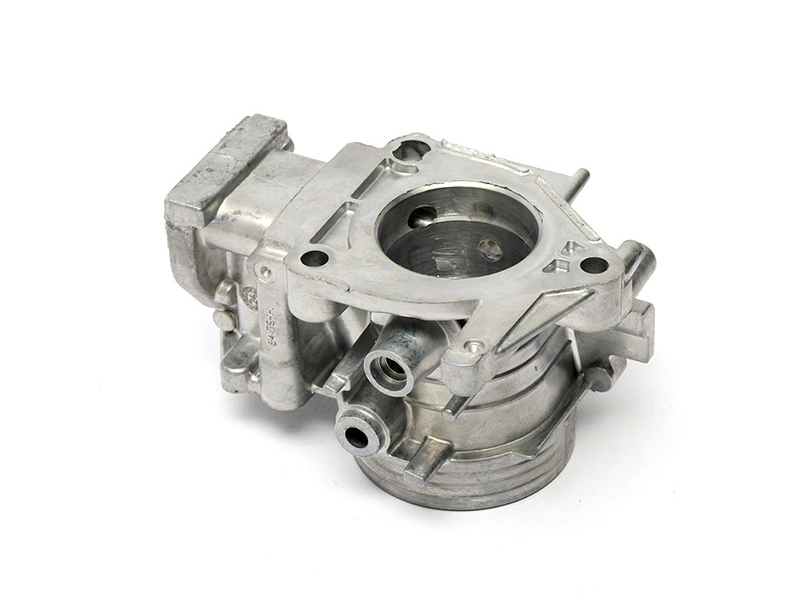
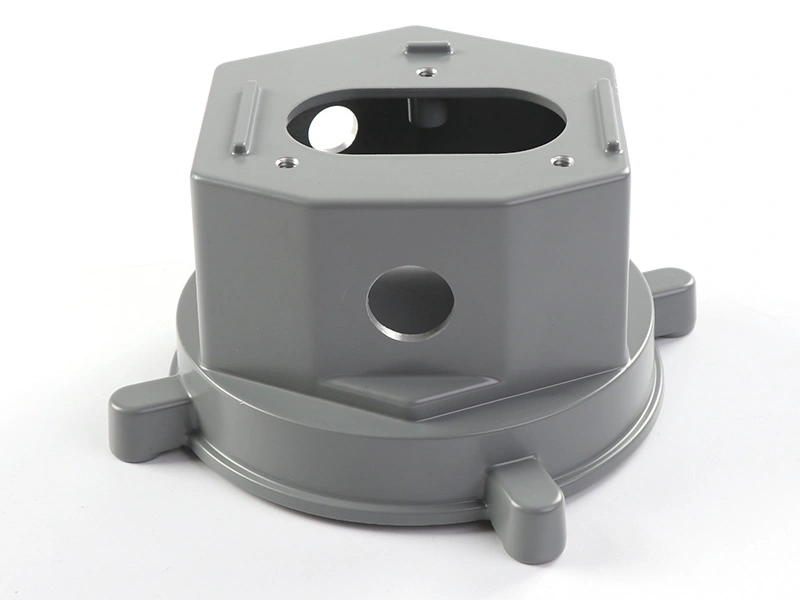
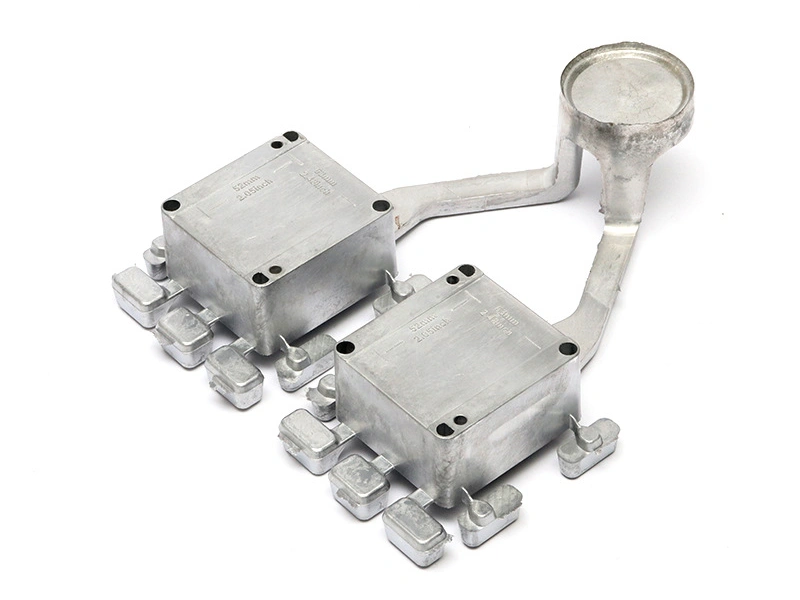
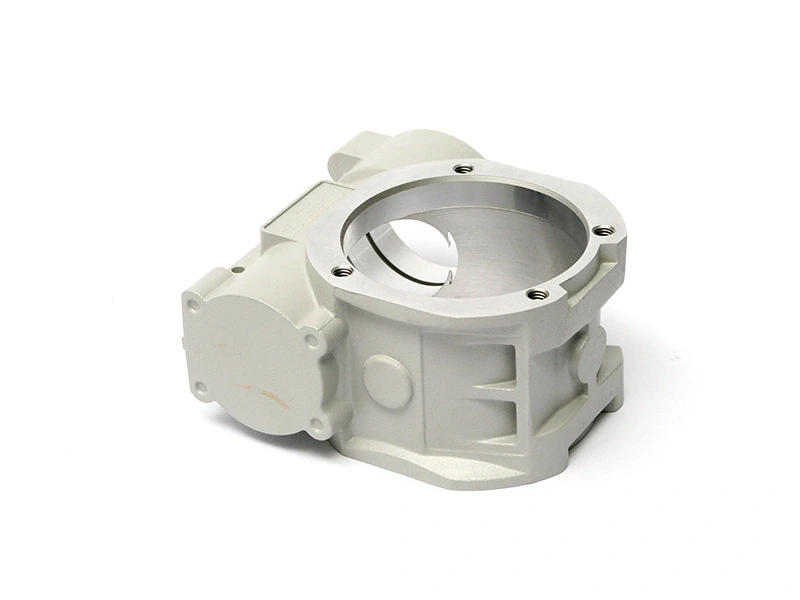
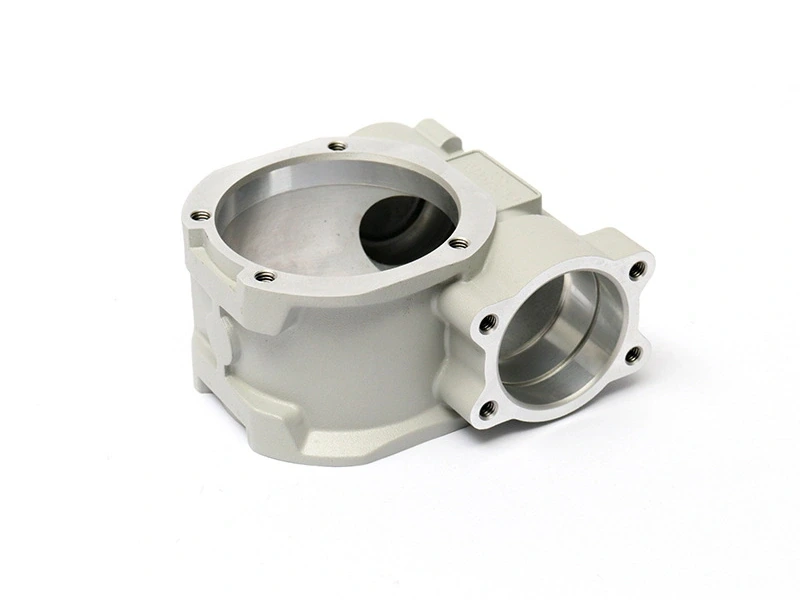
Consider a hypothetical cast aluminum enclosure exposed to coastal aerosol and sunlight. It has sharp external edges, threaded openings, a machined gasket land and a grounding pad. The photographs above show a powder-coated casting example but do not prove aluminum or this application.
The buyer compares an anodized route with a conversion-pretreatment-plus-powder system. Actual alloy trials show whether anodized appearance and coverage are acceptable. For powder, the plan controls degreasing, rinsing, conversion treatment, drying, film and cure while watching for pore outgassing. Edges receive radius and coverage review.
Threads and gasket land are masked to dimensioned boundaries. The grounding pad remains bare but is protected from trapped moisture and galvanic contact through assembly design. Validation includes film thickness by zone, adhesion, cure, cosmetic defects, scribed corrosion behavior and final fit. Salt-spray duration is not translated into years of coastal life.
The approved route records alloy/lot, pretreatment chemistry, powder identity, process window, mask map, test criteria, packaging and field-damage repair. If no system meets edge and joint requirements, the team changes geometry or assembly rather than asking for more topcoat over the same failure mechanism.
How Buyers Should Interpret Salt-Spray and Adhesion Tests
Salt spray is a comparative accelerated test under a named standard and specimen preparation. Record substrate, alloy, casting condition, pretreatment, coating, film thickness, cure, scribe tool and geometry, edge condition, exposure time and failure criteria. Report blistering, base-metal corrosion, coating loss and creep from the scribe separately.
Adhesion tests also need context. Cross-cut or pull-off results depend on film thickness, cure, substrate, cutter or fixture and aging condition. A strong coupon result does not approve an inaccessible recess or sharp edge on a casting. Test production-intent parts or representative witness areas and inspect known difficult zones.
The key limitation is translation. Neither hours nor adhesion class directly predicts service life in UV, cyclic rain, immersion, chemical wash or a galvanic joint. Use relevant test methods as qualification and process-control evidence, then add field- or application-specific tests where consequence justifies them.
How Packaging, Installation and Field Damage Affect Corrosion Protection
A qualified coating can be defeated after inspection. Parts rubbing in transit create chips at ribs and edges. Hard dividers mark broad cosmetic faces. Moisture trapped in non-breathable packaging can condense during temperature changes. Labels or tapes may transfer adhesive that attacks appearance or interferes with a later seal. Packaging should protect coated faces without creating a wet crevice.
Installation instructions should control tool contact, fastener washers, torque, isolation of dissimilar metals and removal of temporary caps. A steel bracket placed directly on a damaged aluminum edge can create a galvanic and crevice condition that no original coupon represented. Where field drilling or trimming is permitted, the instruction must define swarf removal, bare-edge pretreatment and an approved repair stack.
Define acceptable damage by function and exposure. A superficial mark that does not break the film is different from a chip exposing aluminum near a gasket. Local touch-up is valid only when the surrounding film is sound, corrosion products and contamination are removed, substrate loss remains within engineering limits, and the repair material is compatible. Widespread blistering or underfilm corrosion requires root-cause action rather than larger cosmetic coverage.
Include packaging and repair samples in qualification when delivery or field handling is severe. Record repair material, preparation, overlap, cure, inspection and whether repaired parts need exposure retest. This closes the protection route from coating line to installed component.
What Should Be Included in a Corrosion-Coating RFQ?
RFQ Condition | Coating-System Decision | Required Test | Approval Evidence |
|---|---|---|---|
Alloy, casting process and lot control | Substrate response and pretreatment trial | Material confirmation and coated actual-part check | Lot-linked record and qualified sample |
Exposure, fluid, UV and temperature | Conversion, anodizing, paint, powder or MAO candidate | Environment-relevant corrosion/weathering method | Named standard, preparation and failure criterion |
Edges, recesses and drainage | Coverage, radius, vent and application route | Zone film and post-exposure inspection | Part map with minimum/maximum control locations |
Threads, seals, fits and contacts | Masking and thin-film requirements | Dimension, gauge, assembly and function | Approved mask map and finished-part report |
Color, texture and defect standard | Topcoat and appearance process | Color/gloss/visual method as applicable | Master sample and viewing condition |
Packaging, maintenance and repair | Scratch prevention and field touch-up boundary | Pack trial and repair qualification | Handling specification and approved repair instruction |
Ask suppliers to quote the complete layer sequence and mark assumptions: cleaning, blasting if any, conversion, primer, topcoat or powder, cure, mask, inspection, rework and packaging. A coating price without these stages cannot be compared fairly. The final drawing should define performance and critical process controls without relying on a trade name alone.
FAQ
How Should Coating Damage on Outdoor Cast Aluminum Be Repaired Without Hiding Corrosion?
Why Can Coating Adhesion Change Between Aluminum Casting Lots?
How Should Buyers Qualify Conversion Pretreatment Under Powder Coating on Cast Aluminum?
How Should Bare Aluminum at Mask Transitions Avoid Galvanic Corrosion?
How Should Scribed Salt-Spray Results Be Interpreted for Coated Aluminum Castings?