What Is Aluminum Gravity Casting? A Working Definition
This page treats aluminum gravity casting as a route, not as one part. It answers what the route is, how the mold fills and cools, where the tolerance comes from, and where it stops. The route suits a 4–6 mm wall, a batch that can carry a mold, and a part that needs machining after casting. The trade-off is a mold paid up front and a slower cycle than die casting.
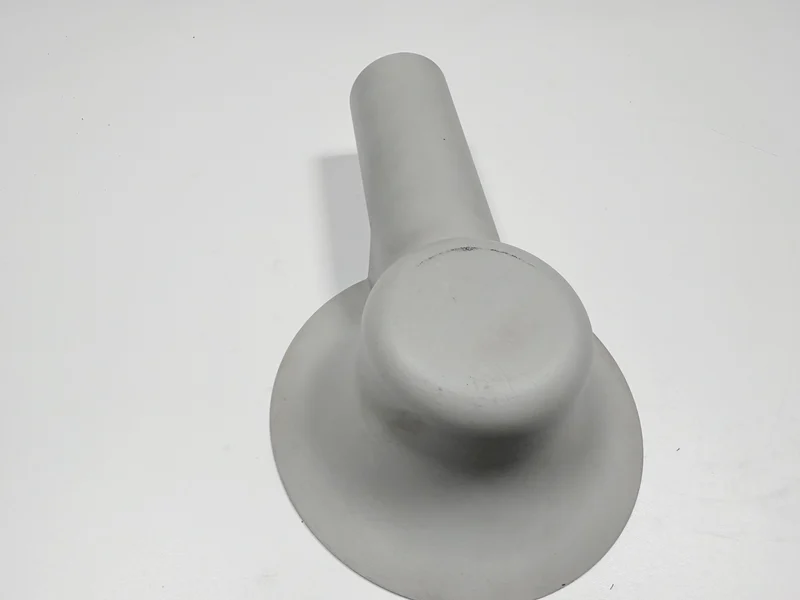
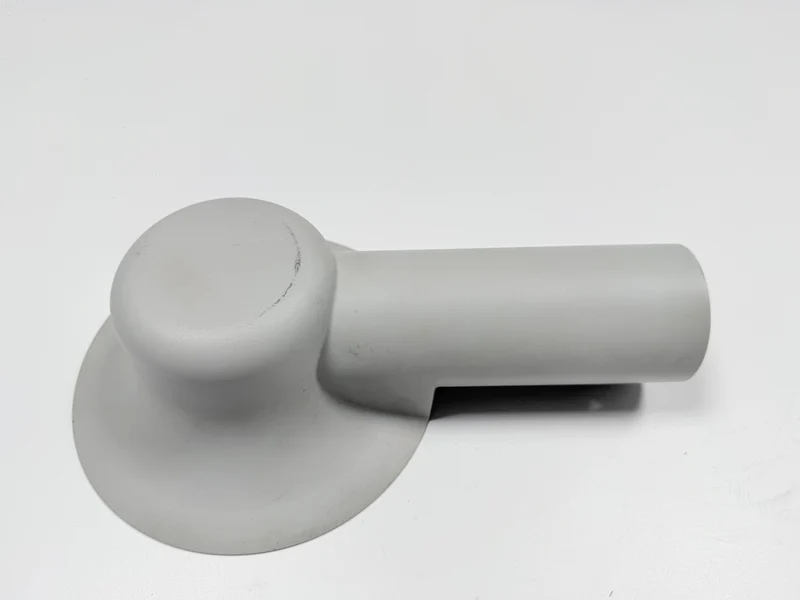
The route is neither sand casting nor die casting. A sand mold is a cavity packed in bonded sand, and a die-casting tool is a hardened steel die fed by a shot piston at high pressure. Gravity casting sits between them: a metal mold, a slow fill, and a casting that is already formed before the first cut.
What is aluminum gravity casting?
Aluminum gravity casting is a metal-mold process: molten aluminum at 700–740 °C fills a cavity under its own weight, and no piston drives the fill. The mold is cut from steel, and some shops call it a permanent mold; it carries the cavity, the gate, the riser and the core. The route casts A356 (AlSi7Mg) in the as-cast F temper, which means no heat treatment after casting; the GB/T 1173 ZL101A designation is pending confirmation. The mold yields one or two parts per pour.
How does gravity casting work?
The pour enters at one gate cut in the mold. From there the metal fills a cavity that vents at the parting line, the joint between the two mold halves. The gate and the riser sit in the tool, and their positions set the fill path and the feed path. The riser, a reservoir that stays liquid after the cavity fills, feeds the shrinkage that follows (the volume loss as the metal sets).
The 250–350 °C preheat keeps the stream liquid long enough to reach the far end. A cold mold would chill the front of the stream and stop the fill early.
Why does a metal mold cool faster than a sand mold?
A steel mold draws heat out of the 4–6 mm wall along a metal path. The heat leaves fast, so the skin freezes early and the casting keeps a finer structure and a tighter surface than a sand casting. That tighter skin is why a gravity casting can be machined with less stock.
A sand mold holds the heat instead. It cools slowly, leaves a rougher surface and needs a deeper cut, and its tooling cost is lower because the mold is packed sand, not machined steel.
Does the mold coating change the casting skin or the cooling?
The coating on the cavity wall changes both the skin and the cooling, because it is the first barrier between the metal and the steel. A thin layer slows the heat the steel would otherwise pull out of the stream. A thicker coat insulates more, so the metal stays liquid longer and the fill reaches farther.
The same coat sets the skin against the wall. A coat that is too thin lets the steel chill the surface fast, and a coat that is too thick keeps the section hot, so the structure coarsens. The coating also helps release, and its thickness is a process setting rather than a drawing callout.
What tolerance can aluminum gravity casting hold?
A tolerance on this route comes from two sources, the mold and the setup, so the limit a drawing can call depends on the feature. Cavity dimensions, the parting line, draft and ejection all sit in the tool, so a cast boss or wall can only be as true as the steel. A machined surface or bore takes its position from the datum (the reference surface for the cut) and the clamping, and one setup holds both features to that datum. The final gauge confirms the result and does not create the tolerance.
The drawing may call a 0.05 mm flatness callout, a 20 mm H9 bore and a 0.1 mm perpendicularity callout, all as drawing targets. H9 is a hole tolerance band; the mold leaves stock on the bore, and the setup cuts it to size. A plate, plug gauge or coordinate measuring machine (CMM) checks the free part, not the clamped one.
A steel or sand core forms the bore, and a core that shifts moves the bore and thins the 4–6 mm wall, so the first article checks that wall. A sand core is consumed per part and adds a removal step; a steel core stays in the tool.
The machining step is where that setup is fixed, and the flatness control on a cast housing follows the same logic. An acceptance test confirms a drawing limit; it is not a service rating. The pressure test at 0.9 MPa, held for 60 s, is one example.
How do you keep the thick section from shrinking?
Feeding keeps the thick section from shrinking: gate and riser placement makes the casting set in one direction. Along a 4–6 mm wall, the thin end farthest from the riser sets first, and the front moves back toward the riser, which stays liquid and feeds the shrinkage behind it. A thick section holds heat longer than the thin wall beside it, so where the wall thickens far from the riser, that section lags the front and is the last zone to set, the hot spot. The riser has to feed that hot spot through metal that is still liquid.
That is directional solidification: the feed path has to stay open from the riser to the last zone. How close the riser must sit is a tooling decision. If the hot spot sits too far away, the thin wall between it and the riser sets first and closes the path. The last metal then pulls apart into shrinkage porosity, the porosity left where feeding stops.
Should a job use gravity casting or die casting?
A metal mold that yields one or two parts every pour carries a slow cycle and a tooling bill paid once, so its cost per part falls only as the batch grows. A die-casting die carries a larger tooling bill, and a shot piston fills a thinner wall in a short cycle. Its cost per part then falls fast at a high annual volume.
That crossover depends on part size, wall and program length, so no single batch number decides it. Two questions decide the route: does the wall fall below the 4–6 mm band, and does the annual volume spread the die cost? Die casting wins when the wall falls below the band and the annual volume carries the die cost.
An in-band wall keeps the job in the gravity mold at small and mid lots; at large lots it moves to die casting once the die cost and a re-qualification bill are paid. A wall below the band at low volume sits outside both routes and needs a third option.
A switch to die casting is not a line swap: the die casting grade replaces A356-F, and the 0.05 face and the H9 bore go back on the drawing as either cast plus one setup or cut in machining. The desk quotes the crossover per drawing, against the stock band, the first-article count and the cavity count.
| Route | How the mold fills | Mold material | Wall type | Where it pays |
|---|---|---|---|---|
| Metal-mold gravity | Weight of the metal | Steel | Mid wall | Small and mid lots |
| High-pressure die casting | Shot piston | Hardened steel | Thin wall | Large lots |
| Sand casting | Weight of the metal | Bonded sand | Thick wall, more stock | One-offs and large parts |
What is the minimum wall thickness for gravity casting?
The normal window for this route starts at a 4–6 mm wall, and that band sets the minimum. A wall that runs thinner is hard to fill because the metal loses heat to the steel faster than it travels. The front of the stream freezes first, and the wall ends in a cold shut (a seam where two streams met without fusing) or a short fill before the metal reaches the far end.
A coating and a hot mold help, but they cannot push the wall past that band. High-pressure die casting fills a thinner wall with a shot piston, and that is the route a thin wall usually takes. The drawing decides the wall, and the wall is one of the first things that decides the route.
Can you anodize A356 aluminum castings?
The data on hand gives no A356 anodizing result. It covers high-silicon aluminum, where the anodized film comes out dark and thin, so whether A356 can be anodized, and to what film thickness, has to be confirmed on a sample before the drawing calls for it.
A356 is an AlSi7Mg alloy, so silicon is present as particles in the aluminum matrix. Anodizing grows an oxide film from the aluminum matrix in an electrolyte, and those particles do not take the film; as silicon rises, the coating thins and darkens.
The cast surface ships as a Sa 2.5 blast to ISO 8501-1; machined faces and bores stay unblasted.
Send the drawing to the quotation desk with the alloy and the finish callout before the mold is cut.
FAQ