Zamak 5 for Bezel Retaining Rings: Thin Wall, Claws, Plating
Zamak 5 suits a Ø26 mm retaining ring because three properties line up: it fills a 0.8 mm wall, its claw roots take the press force, and it carries a plating stack. The grade is ordered as zinc alloy stock to ASTM B86 AC41A in the cast state, at 6.6 g/cm³ typical.
Those properties are also the limits. The ring presses on the crystal and never comes apart for a second attempt, so the alloy has to hold a fit as well as a shape. Every number below is a drawing target or a typical value.
Why does Zamak 5 suit a 1.8 g retaining ring?
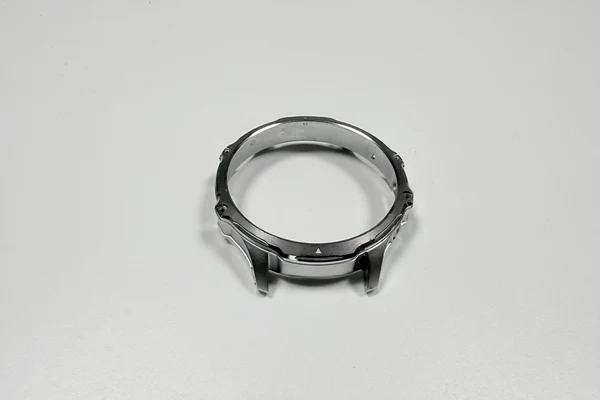
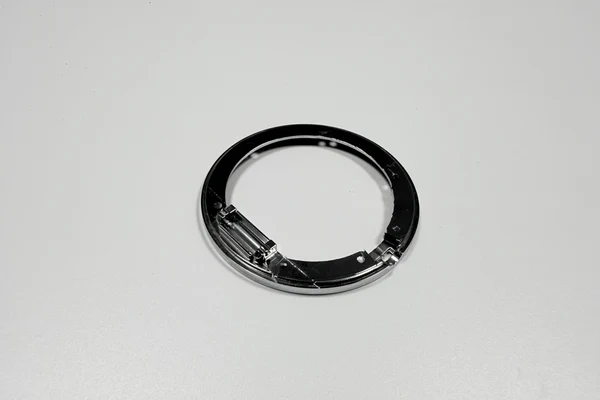
Because the ring is a shape with a duty, not a beam. It holds the crystal on three claws, meets the case wall and looks finished, and a metal that fills a thin section suits that better than one picked for impact. Die casting forms the claws in the same shot as the band.
The alternatives give up different things. Stainless takes impact that zinc will not, yet shaping that claw from sheet leaves springback to control. A molded ring costs less at volume and loses the metal look and the temperature range.
What does 6.6 g/cm³ density mean for a 26 mm ring?
Density turns volume into the weight a wearer feels. At 6.6 g/cm³, the 1.8 g target works out to 0.273 cm³, the metal budget for the whole part.
A plain band of Ø26.0 mm outer diameter, 24.4 mm bore and 2.0 mm height encloses 0.127 cm³, or 0.84 g. The other 0.15 cm³ sits in the three claws and the base step, so the mass is not in the band. These figures are a calculated example on nominal dimensions.
Density is fixed at 6.6 g/cm³ for the grade, so weight is settled by volume. A target outside the 1.8±0.2 g band at this volume is a section change, not a grade change.
What does a 0.8 mm wall do to fill and strength?
A 0.8 mm wall is where fluidity and die heat meet. Zamak 5 typically runs at 400–420 °C melt and 150–180 °C die, and a band that thin freezes outside that window before the far side fills, leaving a cold shut where the fronts met.
The wall also sets the claw root, since a root cannot be thicker than the section it grows from. That cap is why the press force band belongs on the drawing, ahead of the assembly bench.
Going thinner buys nothing. Below 0.8 mm the fill window narrows and trial shots rise, and trial shots are tooling time rather than metal.
What does ASTM B86 AC41A fix on the drawing?
It fixes the alloy family, the cast state and the impurity limits that decide how the surface plates. A ring bought to AC41A is bought to a known composition, so a batch that plates with blisters can be traced to the metal.
The practical result is one line: Zamak 5 to ASTM B86 AC41A, cast state. The rest of the ring is geometry and finish.
| Property | Set by | Drawing target | Allowed range | Checked with |
|---|---|---|---|---|
| Density, cast | Alloy data | 1.8 g | 1.8±0.2 g | Scale |
| Wall | The die | 0.8 mm | 0.8±0.05 mm | Micrometer |
| Claw height | Trimming | 1.2 mm | 1.2±0.05 mm | Height micrometer |
| Nickel film | Plating spec | 3 µm inside | 3 µm floor | X-ray |
| Growth, Cu/Ni/Cr | Calculation | 0.026–0.041 mm | Inside 0/-0.05 mm | Ring gauge |
| Press force | Press trial | 200 N ceiling | 80–200 N | Press bench |
A value with no check behind it is a wish, and a check with no target becomes an argument at goods-in.
Why does nickel plate thin inside a ring cavity?
Because the cavity shields current. The inner wall sits behind the band, so the deposit builds more slowly there, and an outer face at 3–5 µm says nothing about the inside.
Coverage is film thickness at 3 µm or more, read by X-ray. A bright band and a thin inner wall can sit on one ring.
The fix sits in the rack and the masking, since tank time cannot reach a shielded face. That work is priced inside post machining, which is why a 1.8 g ring can carry a plating cost out of proportion to its weight.
Which Zamak grade fits a pressed retaining ring?
Zamak 5 is the usual pick for a pressed ring because it balances castability and strength above the lower grades and plates on the same lines. The field is set out in the zamak alloy selection guide.
The grade is not a free choice at the end of a project. Moving to another Zamak grade changes casting temperature, shrinkage and plating response, so it reopens the first article and adds a trial to the tool.
A drawing that says only Zamak leaves the foundry to pick, and the pick may be the grade that casts easiest rather than the one that plates best. Name grade and standard together and the pick closes.
Does Zamak 5 hold a claw root under press force?
It holds inside a band of 80–200 N. The root is a stress riser on a 0.8 mm wall, and it breaks there before it bends, so the load that matters is the one the press applies.
Strength at the root comes from cast structure and radius. A shrink hole at the base of a claw decides whether that claw bends or breaks, and the overflow outside the root feeds that section as it freezes.
The example record shows the failure: seven roots broke in 1,000 pieces at 320 N, 1.6 times the upper limit, and a root radius of R0.2 mm plus a stroke stop brought the count to zero.
When does stainless stamping win over Zamak 5?
When the ring has to take impact, or when the wall must go below 0.8 mm to fit a shallow case. Stainless is stronger per section, and a stamped claw holds an edge a cast claw cannot match.
The trade is forming. Cutting a defined root in thin sheet moves the tolerance problem from the die to springback, so the first article becomes a press trial.
The switch is a tooling decision as much as a material one, since a zinc ring in production needs a new tool to become a stainless ring. A plated Zamak case frame shows how far the zinc route reaches first.
When does plastic win over Zamak 5?
Where the ring only fills a gap and no plating is called for, plastic wins. A plastic ring costs less at volume, does not corrode, and a case that needs a spacer does not need metal.
The trade is surface and temperature range. A plated zinc ring reads as metal and holds a claw height that a plastic ring cannot repeat, so the crystal seat settles the choice.
The boundary is the press fit. If claws at 1.2±0.05 mm hold the crystal under 80–200 N, the material is zinc or stainless, and the case frame it presses into sets the wall and finish.
What changes if the finish moves to Cu/Ni/Cr?
Color changes less than the arithmetic does. Nickel at 3–5 µm adds 0.006–0.010 mm across the diameter as a calculated figure. A Cu 8–12, Ni 5–8 and Cr 0.1–0.3 µm stack totals 13.1–20.3 µm, or 0.026–0.041 mm.
Against the 0/-0.05 mm band on Ø26.0 mm, the stack spends more than half the allowance. The finish belongs on the drawing with a pre-plate or post-plate note, and the surface finishing choice becomes a fit decision.
The call fails when growth is worked out after plating. A ring at nominal arrives over size, stripping adds a second pass of variation, and the new plating lot carries a first article of its own. Send the grade, the finish stack and the press-trial case with the drawing.
FAQ