ADC12 Tensile Strength After T6: 400 MPa for Robot Frames
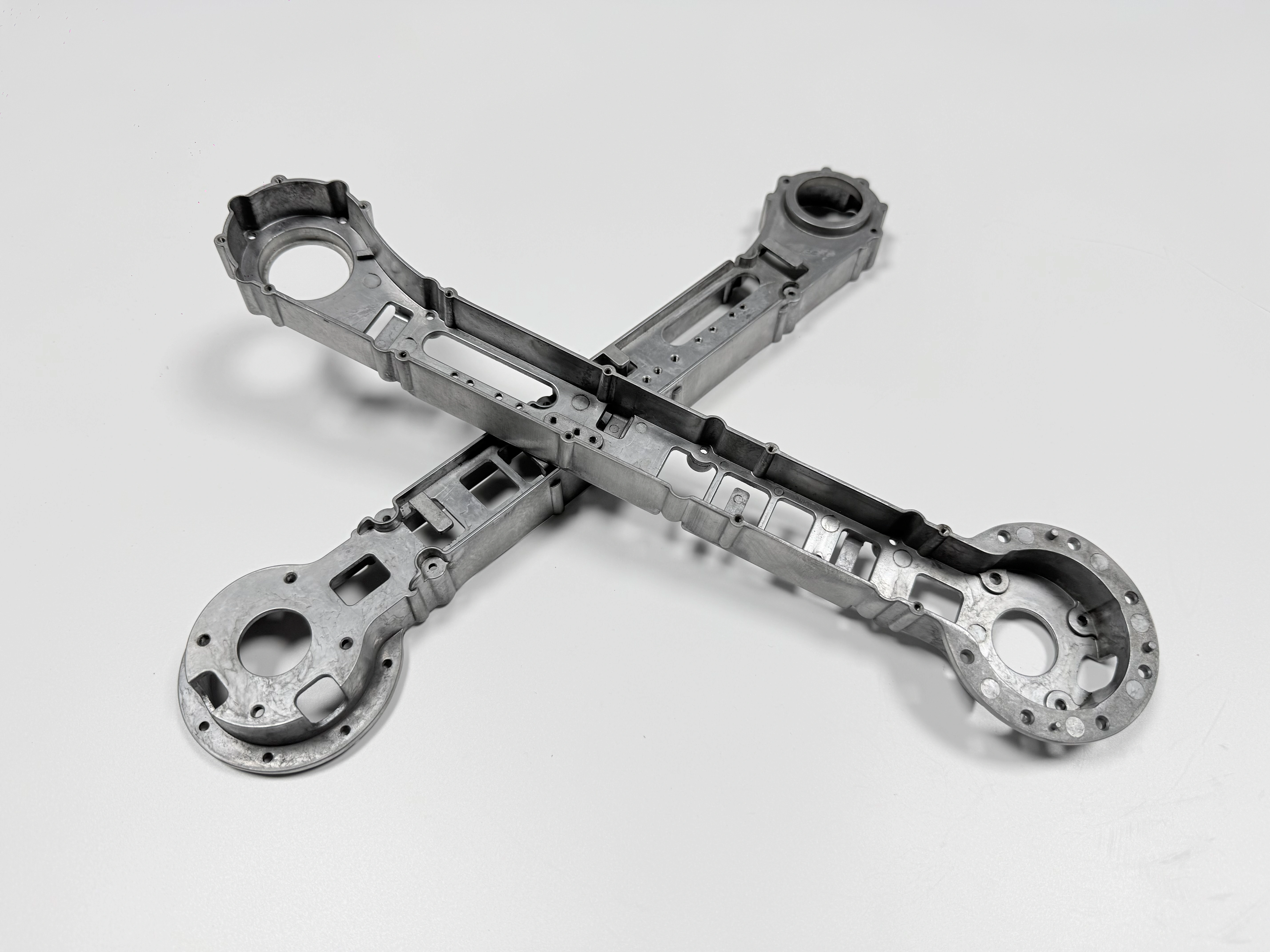
ADC12 tensile strength at 400 MPa is a T6 target on this robot frame, not a number the grade supplies on its own. ASTM B85 fixes the grade and its chemistry. The standard does not state what a 490–510 °C solution will do to a 1.5 mm wall. Casting material selection picks the grade; the furnace, the gas content and the test bar pick the number.
What ASTM B85 Fixes and What It Leaves Open
B85 is the specification for aluminum-alloy die castings. It lists the grades, the chemical limits behind each one, and the tensile properties of separately cast test bars where a grade carries them. A B85 certificate answers a chemistry question about the melt.
The part stays outside it. B85 does not know the wall runs 1.5 mm, that the die holds one cavity, or that the frame enters a T6 furnace after the gate is trimmed. None of that is a gap in the standard; a grade document is not a process document. The drawing closes it by putting the grade, the heat treatment and the tensile method on one sheet.
ADC12 and A383: One Alloy, Two Names
ADC12 is a Japanese grade under JIS H 5302. A383 is the ASTM B85 grade beside it, and both describe the same high-silicon, copper-bearing die casting alloy. The name travels between the two systems. The acceptance does not. Each standard writes its own limits, so a certificate to one is not a certificate to the other.
A drawing that says ADC12 and stops leaves the basis open, and a molder can certify to either system. Write the pair instead: ADC12 to JIS H 5302, or A383 to ASTM B85. The ADC12 (A383) alloy page covers the grade the plant casts; the drawing still picks the standard.
400 MPa Sits Above the Cast State
The 400 MPa figure is a target written after the T6 cycle, not the value an as-cast ADC12 frame carries. It is also not a constant of the grade, and no certificate supplies it. A purchase order that names 400 MPa without the heat treatment names a delivery the foundry cannot make.
A target is still an acceptance value, so it needs a method beside it. Read as a typical property, it invites a quote on the cast state and a rejection on a bar that was never run. Parts that skip the furnace carry a lower stated target, and the T5 fallback changes the drawing status as well as the furnace card.
T6: Solution 490–510 °C, Aging 150–170 °C
T6 is a solution treatment, a quench and an artificial age. The solution runs at 490–510 °C and the age at 150–170 °C. The arithmetic of the windows is short: 510 − 490 = 20, and 20 ÷ 490 ≈ 4%, so a furnace drifting 25 °C misses the band.
Quench medium, transfer time and soak time are not fixed in the part specification, so the cycle is confirmed with the foundry before the drawing is released. Read the two windows as one setting. An age run toward 170 °C trades strength for stability, and a solution below 490 °C leaves the copper-rich phases undissolved, which gives the age nothing to precipitate. The heat treatment for aluminum die castings page covers the mechanism.
Variable | Value | Unit | Evidence |
|---|---|---|---|
Solution temperature | 490–510 | °C | Furnace record, cycle confirmed with the foundry |
Aging temperature | 150–170 | °C | Furnace record for the same load |
Tensile target after T6 | 400 | MPa | Test bar cast with the heat, pulled to ASTM B557 |
Wall at the joint boss | 1.5 | mm | Drawing, design target |
Gas Content Decides Whether T6 Is Possible
A blister comes from gas already inside the casting. At 490–510 °C that gas expands, the skin softens, and a bubble lifts where the wall is thinnest. The furnace did what it was told; the fill left the gas behind.
Gas content is therefore the gate on T6, and vacuum die casting sits ahead of the furnace for that reason. A 1.5 mm wall filled at high speed carries more gas than a thick section, and the far end of the fill is where a cold shut or a short fill shows. The gas porosity map covers where those voids sit.
Evidence comes in two pieces. A bar cast with the same heat and pulled to ASTM B557 reports the melt and the furnace load. X-ray or CT reports where the void sits. Neither turns a gassy casting into a sound one, and a batch that blisters goes back to the fill, not to a longer soak.
1.5 mm Wall: What the Alloy Buys and Costs
ADC12 fills a thin section because of its silicon content and its fluidity, and 1.5 mm is the design target on this frame. The alloy buys the fill. It does not buy the process window: one cavity, vacuum assist and an overflow at the far end of the wall, where the metal arrives last and coldest.
The cost appears in what the wall cannot do. A 1.5 mm as-cast wall is not a datum and not a seat. The joint face is machined after the frame is straightened, so the wall carries load and holds shape while the seat is cut somewhere else. The thin-wall wall thickness discussion covers a housing wall; a load-bearing frame adds the T6 cycle and the machining step.
Requirement | Target | Unit | Held by |
|---|---|---|---|
Tensile after T6 | 400 | MPa | Heat treatment and the same-heat bar |
Wall thickness | 1.5 | mm | Vacuum fill in a single cavity |
Assembly face | ±0.02 | mm | Straightening, then CNC |
MAO film | pending | µm | Film thickness gauge, masks on fits |
Quench Distortion Against ±0.02 mm
The quench cools a 1.5 mm wall first and the joint boss last. That difference is distortion, and it lands on the face that has to hold ±0.02 mm. A higher tensile target does not stop the movement, because the quench that produces the strength produces the movement.
Straightening sits between the T6 and the CNC for that reason. It brings the frame back into a workable envelope and leaves residual stress that the cutter releases a second time. So the seat is cut after straightening, and the datum comes from a machined face rather than from the as-cast wall.
MAO on ADC12: Silicon, Film, Fit
Micro-arc oxidation builds its film out of the aluminum matrix, with no electroplated underlayer, and the film grows both into the surface and above it. ADC12 carries silicon particles that take no part in the film, so the coating follows the matrix between them and can read uneven across one face. Film thickness is still to be measured, so no µm figure appears here.
The fit consequence is short. An assembly face held to ±0.02 mm that receives the film no longer holds ±0.02 mm. Mask threads, fits, grounding points and datums before MAO coating, and put that mask list on the drawing. A missed item surfaces at assembly, not at the coating line.
Cutting Fluid and Humidity: What the Film Must Take
The frame works in industrial automation, around cutting fluid and humidity. The film has to survive that, and a salt spray result is the usual way to argue it. The standard and the duration are still to be fixed against the measured film, so the drawing carries the requirement and leaves the number open until the coating house returns one. An hour count written early creates a reject later, because the test then measures a specification nobody validated.
When ADC12 Loses to Welded Steel or A356
Two alternatives sit beside this route: a welded steel structure and A356 in gravity casting. Steel wins when the frame is a set of plates and tubes a weld shop can build without tooling. The cost is mass, heat-affected zones and a datum that no longer matches a casting drawing.
A356 wins when the part needs a T6 result and can carry thicker sections. Gravity casting leaves less gas in the metal, and the alloy responds to the treatment with more margin. The cost is cycle time and as-cast tolerance. ADC12 holds the 1.5 mm wall and the volume, and it loses when the gas route cannot be held or the section has to grow. An ADC12 HPDC case shows the route when it holds, and the A356-T6 heat treatment page sets the other side.
FAQ